

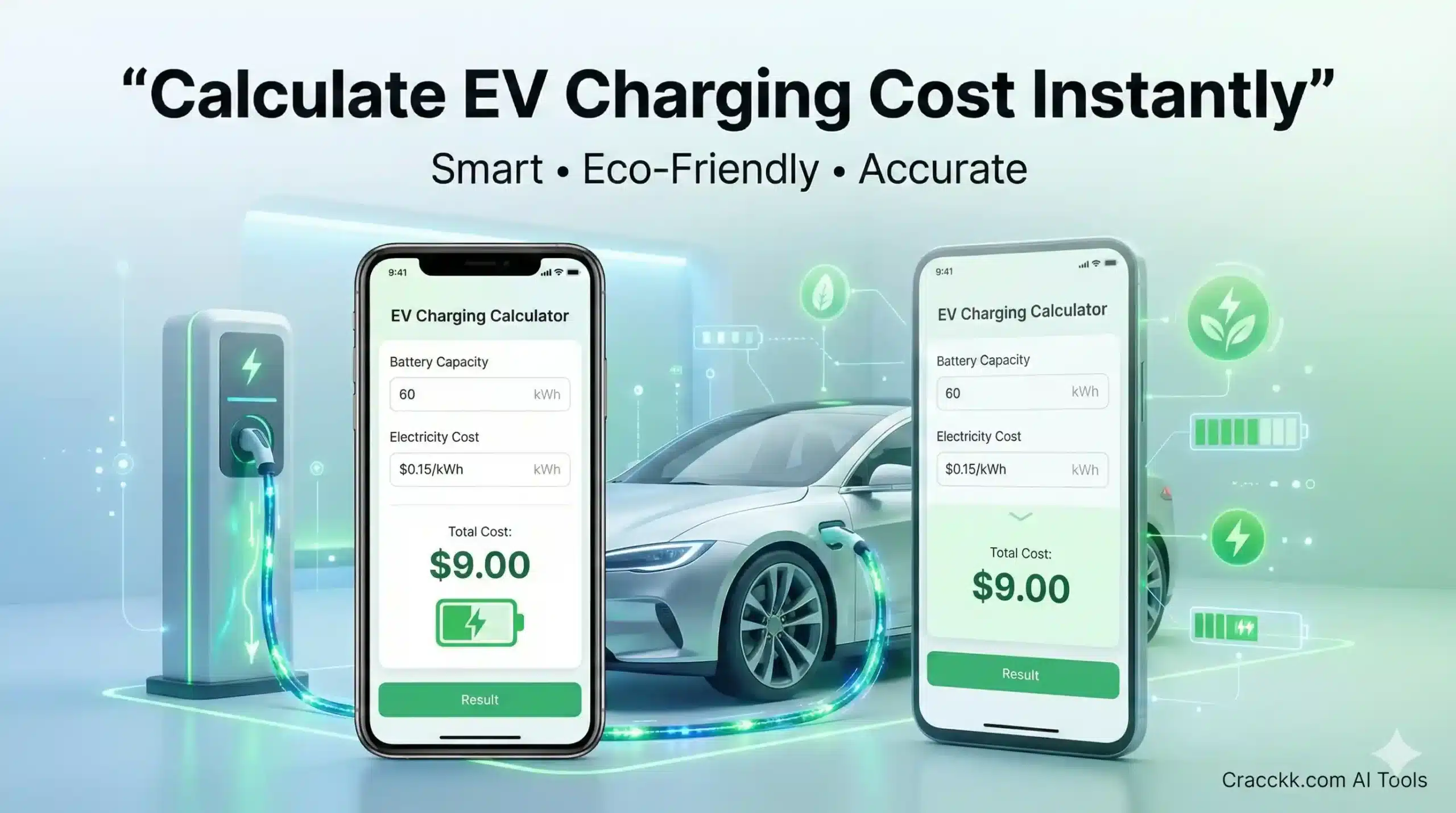
EV Charging Cost Calculator (Mobile)
Estimate kWh needed, charge time and cost. Works for home or public chargers. Fill distance or direct kWh.
How to use the EV Charging Cost Calculator
This free calculator estimates how much electricity your electric car, scooter or bike needs, how long charging will take and what it will cost. It works for home charging and public chargers, and it runs fully in your browser.
- Enter the trip distance in km or miles, or enter the energy needed in kWh directly if you already know it.
- Enter your vehicle’s efficiency: in km per kWh (for example 6.5) or kWh per 100 km.
- Add battery details: battery capacity, your starting charge (SoC) and the target charge.
- Set charging efficiency: some energy is lost while charging. Values between 85% and 95% are typical.
- Enter charger power: home chargers are usually 3.3–11 kW, and fast chargers are 50 kW or more.
- Enter the price per kWh and, if you are sharing the trip, the number of people.
How the cost is calculated
The calculator first works out the energy your vehicle will use: distance ÷ efficiency. It then adds charging losses to find the energy drawn from the charger. Multiply that by the price per kWh and you get the charging cost. Charging time is roughly the energy needed ÷ charger power.
Example
Suppose you drive 200 km in a car that gives 7 km per kWh. The car uses about 28.6 kWh. With 90% charging efficiency, about 31.7 kWh comes from the charger. At ₹8 per kWh at home, the trip costs roughly ₹254. On a 7.4 kW home charger, that much energy takes a little over 4 hours.
At a public fast charger, the price per kWh is usually higher, so try both prices in the calculator to see the difference.
Tips to reduce EV charging cost
- Charge at home when you can: home electricity is usually cheaper than public fast charging.
- Check your electricity tariff: some states and DISCOMs offer special EV tariffs or time-of-day rates.
- Avoid charging to 100% every day: many makers suggest a daily limit of around 80% for battery health. Check your vehicle manual.
- Drive smoothly: steady speeds and less hard braking improve your km per kWh.
- Compare with petrol: use our Trip and Fuel Cost Calculator to compare the same trip in a petrol vehicle.
FAQ
Where do I find my EV’s efficiency?
Most EVs show average km per kWh or Wh per km in the trip meter. You can also use the figure from the manufacturer’s brochure, but real-world efficiency is usually lower.
Does it work for electric scooters?
Yes. Enter the scooter’s battery size, efficiency and charger power. The method is the same.
Is my data stored?
No. All calculations happen in your browser.
Results are estimates. Real costs depend on weather, driving style, charger losses and your exact tariff.