

Best AI Legal Tools for Businesses in India 2026
Introduction
Imagine a small business owner in Pune who had just launched a D2C skincare brand. The product is good, the branding is sharp, and the first few orders are already coming in through Instagram. For the first few weeks, everything feels like it is going according to plan. Then the emails start arriving. A logistics partner sends a service agreement full of liability and indemnity. A new hire asks for an offer letter and an NDA. A potential retail partner wants a distribution agreement reviewed before Friday. A customer emails asking why the privacy policy on the website looks copy-pasted from another brand. Somewhere in between, lies a compliance filing deadline that nobody on the team fully understands.
This is the moment when most founders in India realise that running a business is not just about the product — it is also about contracts, agreements, vendor documents, employment paperwork, legal notices, privacy policies, terms and conditions, regulatory filings, intellectual property, and customer-facing agreements. None of this is optional. Every document carries real legal and financial consequences if it’s drafted poorly, reviewed too quickly, or ignored altogether.
The problem is that most small businesses, startups, and growing companies in India cannot afford to run a full in-house legal department. Hiring a lawyer for every contract review, compliance question, or vendor agreement becomes expensive quickly. A founder juggling product, sales, hiring, and operations often does not have the time or money to sit with a lawyer for hours explaining context for a routine vendor contract. At the same time, ignoring legal work altogether or handling it carelessly is a risk that can come back to hurt a business far more expensively later.
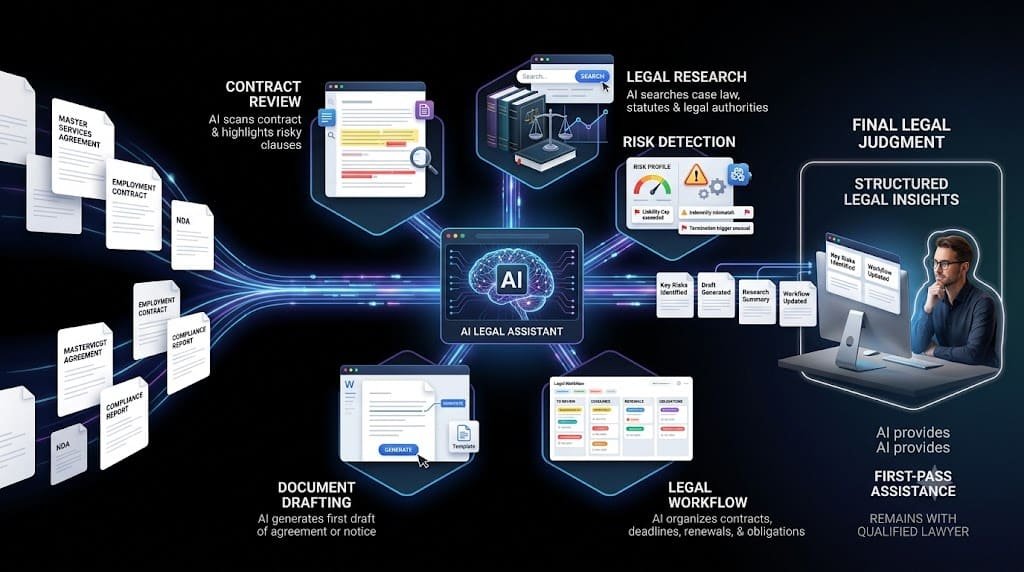
This is where AI legal tools have started to play a genuinely useful role. The best AI legal tools for businesses in India in 2026 are not meant to replace lawyers — they are meant to make legal work faster and more manageable before a lawyer even gets involved. These tools can review contracts and flag key clauses, assist with legal research, highlight potential risks in agreements, help draft first versions of documents, and organise legal workflows so nothing important slips through the cracks. Used well, they give business owners a head start and a clearer starting point before they walk into a conversation with a qualified lawyer.
It is worth being upfront about one thing: AI legal tools are not a substitute for qualified legal professionals, especially when a business is dealing with complex negotiations, high-value transactions, disputes, litigation, or matters that carry significant regulatory or financial risk. In this case, the work is divided into 2 parts. AI, which is great at performing tasks automatically, handles the boring, repetitive work that can be automated; lawyers handle the judgment, strategy and accountability. This guide looks closely at the best AI legal tools for businesses in India in 2026, what each one actually does, who it is built for, and where it realistically fits into a growing business’s legal workflow

Why Businesses in India Are Turning to AI for Legal Work
The rise of AI legal tools in India isn’t happening in a vacuum — it is a direct response to problems founders and small business owners have been adjusting to for years. Legal costs in India can be unpredictable, especially for businesses not on a retainer arrangement with a law firm. A quick contract review or a one-off legal opinion can carry a fee that feels disproportionate to a small business’s budget, especially when that business needs several such reviews every month as it signs on new vendors, clients, and employees.
Contract review itself tends to be one of the most time-consuming parts of running a business. A single vendor agreement or client contract can run into dozens of pages, filled with clauses on liability, indemnification, termination, confidentiality, and dispute resolution. For someone without a legal background, understanding what each clause actually means — and which ones are unusually risky — is genuinely difficult. Legal language is dense by design, and most founders do not have the time or training to comb through it clause by clause for every document that lands in their inbox.
Then there is the sheer volume of repetitive documentation that businesses generate as they grow: offer letters, NDAs, vendor onboarding forms, privacy policies, terms of service, and internal policies. Although it follows familiar patterns, the paperwork still needs to be drafted, reviewed, and kept up to date to keep everyone happy. Compliance adds another layer of complexity — Indian businesses need to navigate company law filings, tax and GST-related obligations, labour law requirements, data protection considerations, and sector-specific regulations, all of which can change over time. Finding relevant, current, and accurate legal information on these topics is not always straightforward, particularly for a business owner who does not know exactly what to search for.
For companies that eventually start managing a large number of contracts — vendor agreements, client contracts, partnership deals, and employment documents — the challenge shifts from simply understanding legal language to actually keeping track of everything. Missed renewal dates, forgotten obligations, and misplaced documents become real operational risks once a business scales past a certain point. AI tools are increasingly being used to bring some order to this chaos, giving businesses a faster way to review documents, understand key terms, and stay on top of what needs attention.
At the same time, it is important to be realistic about what “AI for legal work” actually means in the Indian context. Not every AI tool understands Indian law with the same depth. Some platforms are built specifically around Indian case law, Indian statutes, and Indian regulatory frameworks, while others are general-purpose AI systems with limited grounding in Indian legal specifics. Businesses looking for the best AI legal tools in India should pay close attention to whether a tool actually offers Indian legal research, coverage of Indian case law and regulations, or India-focused contract and compliance capabilities — rather than assuming that any AI tool with “legal” in its name will understand the nuances of Indian law equally well.
What Should You Look For in an AI Legal Tool?
Choosing the right AI legal tool is less about picking the most well-known name and more about matching a tool’s actual capabilities to what your business genuinely needs. A few factors are worth evaluating carefully before committing to any platform.
Indian Legal Coverage. This is arguably the most important factor for a business operating in India. A tool that is trained primarily on US or UK law, or one that relies on general internet knowledge without a grounded Indian legal database, may not reliably understand Indian statutes, recent legislative changes such as the Bharatiya Nyaya Sanhita, or the nuances of Indian case law. Look for tools that explicitly mention Indian legal databases, Indian case law coverage, or India-specific compliance frameworks.
Contract Review. Since contract review is one of the most common use cases for small businesses, it is worth checking whether a tool can genuinely identify important clauses, flag unusual or risky terms, and explain them in plain language — rather than simply summarising a document at a surface level. Some tools are built specifically for contract analysis, while others treat it as a secondary feature.
Legal Research. For businesses that need to understand a regulation, look up a precedent, or get background on a legal question, a tool’s legal research capability matters. This includes how large and current its underlying legal database is, whether it covers Indian case law and statutes, and whether it can search and retrieve relevant material accurately rather than generating answers purely from its own training.
Document Drafting. Many tools now offer AI-assisted drafting of contracts, notices, policies, or agreements. It is worth checking whether the drafts are based on verified templates and Indian legal formats, or whether they are generated in a more generic way that may need heavier editing.
Data Privacy and Security. Business documents often contain sensitive commercial information, and contracts may include confidential terms, financial figures, or personal data. Before uploading any document to an AI tool, businesses should understand how that platform stores, processes, and protects uploaded data, and whether it retains documents after processing.
Accuracy and Citations. One of the most important — and most overlooked — factors is whether a tool provides sources or citations for the legal information it generates. AI systems, including legal AI tools, can occasionally produce inaccurate information or reference cases and sections that do not exist. Tools that link their answers back to actual statutes, case law, or verified sources are generally more trustworthy than those that simply generate an answer with no way to verify it.
Ease of Use. A tool that requires significant technical or legal expertise to operate defeats much of the purpose for a small business owner who is not a lawyer. The best AI legal tools for businesses in India tend to be the ones that present information clearly, in plain language, without requiring the user to already understand legal terminology.
Human Lawyer Review. No matter how capable an AI tool is, any document with real financial, contractual, or regulatory consequences should ideally be reviewed by a qualified lawyer before it is signed, filed, or relied upon in a dispute. The best approach treats AI as a first layer of assistance, not a final decision-maker.
Best AI Legal Tools for Businesses in India
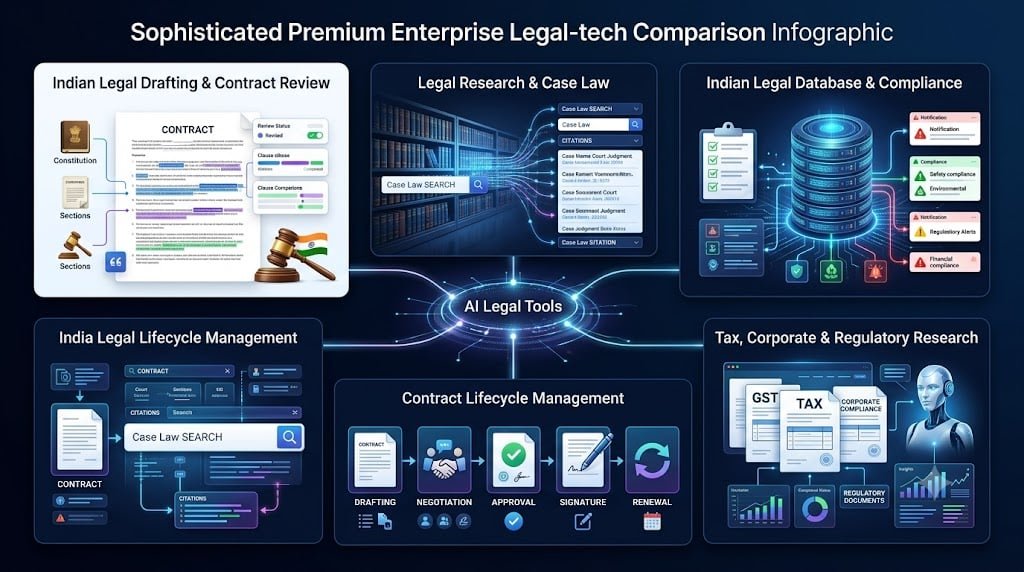
LegalInk AI
LegalInk AI is an Indian legal AI platform built specifically around Indian legal drafting and contract review, with native coverage of the Bharatiya Nyaya Sanhita (BNS) and Bharatiya Nagarik Suraksha Sanhita (BNSS), the criminal law framework that replaced the older Indian Penal Code and Criminal Procedure Code. The platform is designed to help with drafting legal documents, replying to notices, and reviewing contracts, with support for both Hindi and English. One of its more distinctive features is a citation-verification approach: when the tool cannot confirm a legal reference against its verified database, it is designed to flag that gap rather than presenting an unverified citation as fact, and its contract review feature produces a record of which authorities it did or did not verify.
For Indian businesses, this kind of transparency matters, since one of the biggest risks with AI-generated legal content is confidently citing a law or case that does not actually exist. LegalInk AI’s advantage lies in this India-specific grounding and its focus on practical, everyday legal documents that small businesses and individuals commonly need, such as agreements, notices, and RTI applications.
That said, as with any AI legal drafting tool, the output should be treated as a strong starting draft rather than a final, court-ready or negotiation-ready document, and businesses dealing with more complex or high-value contracts should still have a qualified lawyer review the final version. LegalInk AI is best suited for small businesses, startups, and individual professionals who need quick, India-specific document drafting and contract review support without engaging a lawyer for every routine document.
CaseMine
CaseMine is an AI-powered legal research platform that focuses on case law, judgments, precedents, and legal citations across Indian, US, UK, and Irish jurisdictions. Founded in India in 2013, the platform has built its reputation primarily around legal research rather than contract management or document automation. Its AI assistant, AMICUS, allows users to ask legal questions in plain language and receive answers linked back to actual case law and legal authorities, which helps address one of the biggest concerns with AI-generated legal content: unverifiable or fabricated citations.
CaseMine also offers a feature called CaseIQ, which allows users to upload a legal document — such as a contract, petition, or brief — and retrieve contextually relevant precedents and statutory provisions, along with tools for organising research, bookmarking material, and tracking topics over time. For Indian businesses, CaseMine’s strength lies in its coverage of Indian case law from the Supreme Court, High Courts, and various tribunals, combined with AI-driven contextual search rather than simple keyword matching.
The platform is primarily a research and litigation-intelligence tool rather than a contract lifecycle management system, so businesses looking specifically for contract drafting or approval workflows would need a different kind of tool alongside it. CaseMine is best suited for businesses, legal teams, and professionals who need reliable, citation-backed legal research on Indian case law and precedents, rather than day-to-day contract administration.
Manupatra
Manupatra has been one of India’s most established legal research databases since 2000, and it has evolved considerably over the past few years into a broader legal technology suite that now includes AI-assisted research, compliance management, contract management, IP management, and case tracking tools. Its core strength remains its extensive proprietary database, which includes case law from the Supreme Court, High Courts, and tribunals, along with legislative and regulatory material spanning thousands of central, state, and municipal laws.
It is important to be precise about what Manupatra is: it is not purely an AI legal assistant built from the ground up as a conversational AI tool. Rather, it is a long-standing legal research and legal-technology platform that has layered AI capabilities — including natural language search and AI-assisted case summaries — on top of its existing, decades-old legal database. This distinction matters because Manupatra’s real strength lies in the depth and reliability of its underlying Indian legal content, with AI functioning as a way to search and navigate that content more efficiently, rather than as a standalone generative assistant.
For businesses, Manupatra’s compliance management module — which tracks a large number of individual compliance requirements across Indian laws — can be particularly useful for staying on top of regulatory obligations as a company grows. Its limitations are similar to those of any large, established platform: it can feel more geared toward legal professionals and larger organisations than toward a solo founder looking for a simple, quick answer. Manupatra is best suited for growing businesses, in-house legal teams, and professionals who need dependable, India-specific legal research and compliance tracking backed by a long-established legal database.
SpotDraft
SpotDraft is fundamentally different from the tools above in one key respect: it is a contract lifecycle management (CLM) platform, not a legal research tool. Founded in India in 2017 and headquartered in Bengaluru, SpotDraft is built to manage the entire lifecycle of a contract — from creation and drafting, through negotiation, redlining, and approvals, to e-signature and final storage — for legal, sales, HR, procurement, and business operations teams.
Its AI-assisted features are built into this workflow rather than existing as a separate research or chat interface. This includes AI-assisted contract drafting from templates, automatic extraction of key contract metadata and clauses for easier search and reporting, and tools that help teams identify important terms across a large volume of contracts. The platform also supports automated approval workflows, a centralised and searchable contract repository, and reporting on renewals, obligations, and bottlenecks in the contracting process.
This makes SpotDraft particularly useful for businesses that are past the stage of handling a handful of contracts manually and have started to accumulate a genuinely large volume of vendor agreements, client contracts, and employment documents that need to be tracked, renewed, and organised systematically. It is not designed to answer general legal research questions or provide case law analysis, so businesses that need that kind of support would need to pair it with a research-focused tool. SpotDraft is best suited for fast-growing companies, SMEs, and enterprises with in-house legal or operations teams that need to manage contract volume and workflow efficiently, rather than solo founders handling only a few agreements a year.
VIDUR
VIDUR is an AI-powered legal and regulatory assistant built specifically for Indian tax, corporate, and compliance work, and it is used by lawyers, chartered accountants, and business leaders. Its knowledge base draws on commentaries and content from established Indian legal and tax publishers, and it covers areas such as Income Tax, GST, Companies Act matters, insolvency, FEMA, and SEBI regulations. The platform is designed to let users ask questions in plain language and receive answers that include references back to source material, along with the ability to generate drafts such as compliance checklists, client advisories, and notice replies.
One of VIDUR’s more practical features for small business owners and professionals is its accessibility across web, mobile, and WhatsApp, along with a large library of templates and prompts aimed at reducing repetitive drafting and research work. Its focus on staying current with regulatory changes, such as GST notifications and Income Tax updates, makes it particularly relevant for businesses that need to keep pace with frequently changing Indian tax and compliance requirements.
VIDUR’s coverage is concentrated on Indian tax, corporate, and regulatory law rather than broader case law research or contract lifecycle management, so it functions best as a specialised compliance and advisory research tool rather than a general-purpose legal platform. It is best suited for businesses, chartered accountants, and professionals who regularly deal with Indian tax and regulatory compliance questions and want fast, source-referenced answers without digging through lengthy government notifications themselves.
Comparison Table
| AI Legal Tool | Best For | Indian Legal Focus | Contract Review | Legal Research | Business Use Case | Best Suited For |
|---|---|---|---|---|---|---|
| LegalInk AI | Indian legal drafting and document generation | Strong (BNS/BNSS native) | Yes, with citation verification | Limited, drafting-focused | Everyday legal documents and notices | Small businesses, startups, individuals |
| CaseMine | Legal research and case law analysis | Strong (Indian case law + global) | Limited (via document upload) | Strong | Research-heavy legal questions | Legal teams, professionals, researchers |
| Manupatra | Comprehensive Indian legal database and compliance | Very strong (25+ years of Indian content) | Available via CLM module | Very strong | Compliance tracking and legal research | Growing businesses, in-house legal teams |
| SpotDraft | Contract lifecycle management | Moderate (platform, not research-focused) | Very strong | Not a core focus | Managing high contract volume | SMEs, fast-growing companies, enterprises |
| VIDUR | Indian tax, corporate, and regulatory research | Strong (tax and regulatory focus) | Not a core focus | Strong (tax/regulatory) | Compliance and advisory research | CAs, business leaders, compliance teams |
Best AI Legal Tool for Different Business Needs
There is no single tool that wins across every category, and the right choice depends heavily on what a business actually needs help with.
Best for Indian Contract Review: LegalInk AI, for businesses that want quick, India-specific review and drafting of everyday agreements, or SpotDraft, for businesses reviewing a high volume of contracts as part of an established workflow.
Best for Indian Legal Research: CaseMine and Manupatra both stand out here, with CaseMine offering AI-driven contextual case law search and Manupatra offering an exceptionally broad, long-established database of Indian statutes, regulations, and case law.
Best for Contract Lifecycle Management: SpotDraft, given its purpose-built focus on managing contracts from drafting through signature and renewal.
Best for Startups: LegalInk AI or VIDUR, since both are accessible, relatively low-cost entry points for founders who need quick help with documents, notices, or regulatory questions without a large upfront commitment.
Best for Growing Businesses: Manupatra or SpotDraft, since both are built to scale with a business as its contract volume and compliance obligations increase.
Best for Legal Professionals Working With Businesses: CaseMine and Manupatra, given their depth of Indian case law coverage and research tools designed with legal practitioners in mind.
How Businesses Can Use AI Legal Tools
In practice, AI legal tools tend to be most useful for the kind of repetitive, high-volume legal work that businesses encounter constantly but rarely have time to handle carefully. This includes reviewing supplier and vendor contracts before signing them, going through client agreements to understand what obligations and liabilities they create, and comparing multiple versions of a contract to see what has changed during negotiation. AI tools can also help flag clauses that carry unusual risk — such as one-sided indemnity terms, unclear termination conditions, or vague liability language — so that a business owner knows what to raise with a lawyer or counterparty before signing.
Beyond contract review, businesses are using these tools to draft first versions of agreements, internal policies, and notices, which can then be refined and finalised with proper legal input. AI research tools help with looking up relevant regulations or understanding compliance requirements in a particular sector, while contract management platforms help organise existing agreements, track renewal dates, and monitor contractual obligations so nothing is missed as a company scales.
This kind of organisation becomes especially important as a business grows. A company like Infosys, for instance, manages an enormous volume of vendor, client, and employment contracts across its global operations — a scale where even small inefficiencies in contract tracking or clause management could translate into significant risk or cost. While a small business will never operate at that scale, the underlying lesson holds at any size: as the number of contracts a business handles grows, having a systematic way to review, organise, and track them becomes less of a convenience and more of a necessity. AI tools also help business owners prepare more informed questions before a conversation with a lawyer, and they can make dense, complicated legal documents easier to understand at a glance, which saves time on both sides of that conversation.
AI Legal Tools vs Hiring a Lawyer
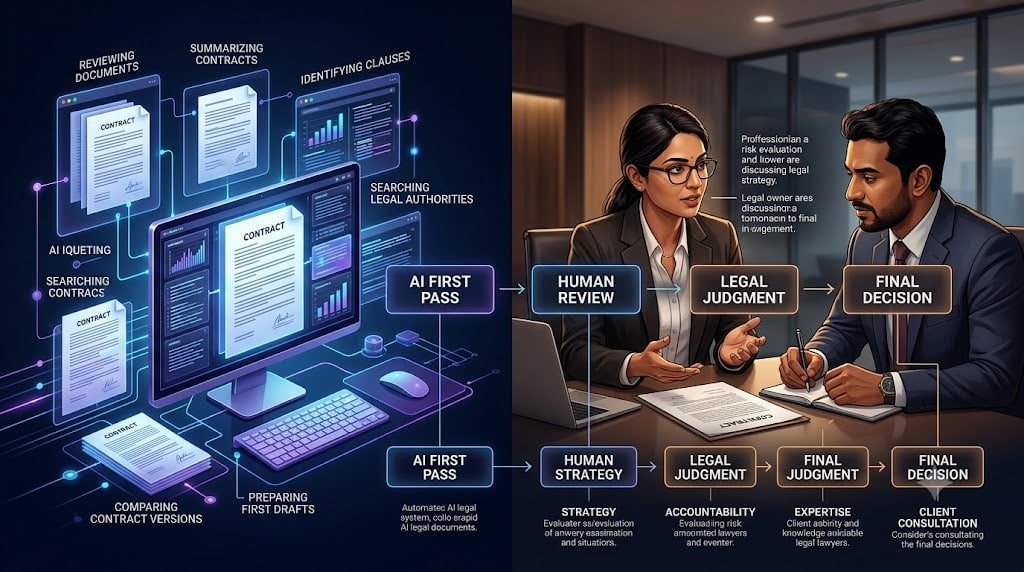
It helps to think of AI legal tools and lawyers as serving different, complementary roles rather than competing directly with each other. AI is genuinely useful for first-pass document review, general research assistance, summarising long or dense documents, identifying potential issues that deserve a closer look, drafting initial versions of routine documents, and handling repetitive legal workflows that would otherwise consume hours of a founder’s time.
Lawyers, on the other hand, remain essential for legal strategy, litigation, negotiation involving significant stakes, drafting and reviewing complex or high-value contracts, navigating regulatory disputes, providing formal legal opinions, and handling any matter that carries meaningful financial, reputational, or legal risk. A lawyer brings judgment, accountability, and an understanding of context and nuance that AI tools, however sophisticated, are not equipped to replace. This is particularly true in matters involving negotiation dynamics, courtroom strategy, or situations where the specific facts of a case matter enormously.
The most effective approach for most Indian businesses is not choosing between AI and a lawyer, but combining both. Using AI to handle the repetitive groundwork — first drafts, research summaries, clause identification — frees up a lawyer’s time to focus on judgment calls, strategy, and the matters that genuinely require legal expertise. This combination tends to be more efficient and more cost-effective than relying entirely on either one alone.
How to Use AI Legal Tools Safely
Using AI legal tools responsibly requires a few sensible habits. It is important to verify AI-generated information rather than accepting it at face value, particularly when it comes to specific legal citations, section numbers, or case references — AI systems can occasionally produce inaccurate or outdated information, so checking citations against the tool’s stated sources, or independently, is a good practice. Businesses should also pay close attention to a platform’s privacy policy before uploading sensitive documents, understanding exactly how uploaded data is stored, processed, and whether it is retained after use.
As a general rule, it is wise to avoid uploading highly sensitive or confidential information to an AI tool unless the platform’s data handling and security practices are clearly documented and trustworthy. Important documents — particularly those involving significant financial value, sensitive negotiations, or potential disputes — should still be reviewed by a qualified lawyer before being finalised or signed. Finally, since laws and regulations change over time, it is worth checking whether the legal information a tool provides reflects current law, especially for tools whose underlying databases may not update as frequently as the law itself changes.
How Much Time Can AI Legal Tools Save?
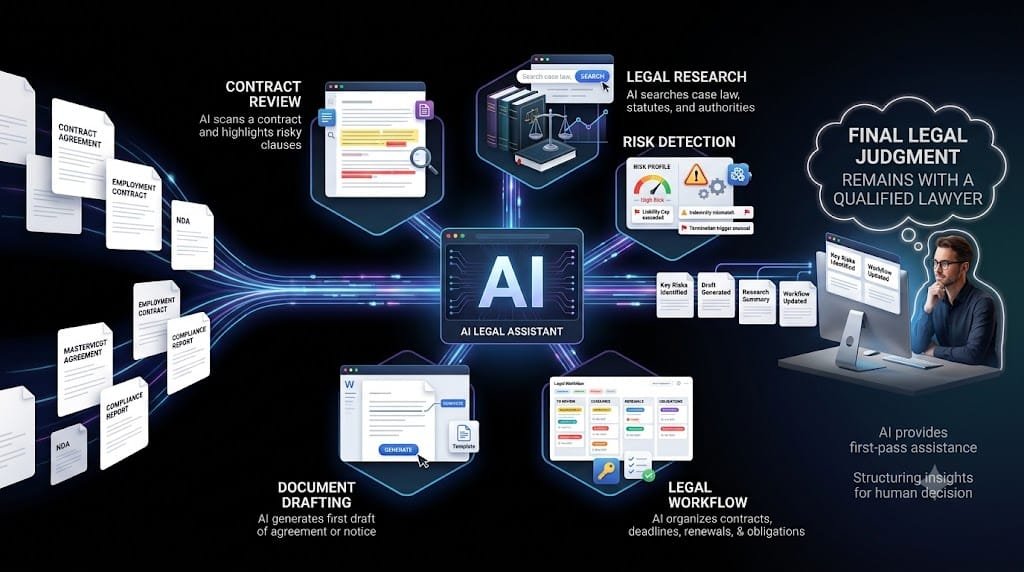
AI legal tools can meaningfully reduce the time businesses spend on certain repetitive tasks, including summarising lengthy contracts, comparing clauses across multiple versions of an agreement, conducting an initial review of a document before deeper analysis, searching for relevant legal information or precedents, organising and tagging existing contracts, and preparing first drafts of routine documents. For a business owner who would otherwise spend hours manually reading through dense legal language, having an AI tool summarise the key points and flag potential issues can genuinely speed up the early stages of that process.
That said, it is important to be realistic rather than promotional about these benefits. The actual time saved varies considerably depending on the complexity of the document, the quality and focus of the specific tool being used, and how much manual verification and legal review is still required afterwards. AI tools reduce the time spent on the repetitive, mechanical parts of legal work — they do not eliminate the need for careful human judgment on anything that matters.
How to Get Started With AI Legal Tools
Step 1: Identify Your Most Repetitive Legal Task. Start by figuring out which legal task consumes the most time or causes the most friction in your business — whether that is contract review, drafting routine documents, or researching compliance requirements. This will point you toward the right category of tool.
Step 2: Choose a Tool Based on Your Actual Need. Once you know your priority, match it to the right kind of tool. A business drowning in contract volume needs a contract lifecycle management platform like SpotDraft, while a business that mostly needs research support might be better served by CaseMine or Manupatra.
Step 3: Start With Low-Risk Tasks. Begin by using the tool on lower-stakes documents — internal templates, routine vendor agreements, or general research questions — rather than jumping straight into your most sensitive or high-value contract.
Step 4: Test the AI’s Accuracy. Before relying on any tool for real work, test it against documents or questions where you already know the correct answer. This helps you understand where the tool is reliable and where it tends to fall short.
Step 5: Create a Human Review Process. Decide in advance which categories of documents will always require a lawyer’s review before being finalised, regardless of what the AI tool produces. This keeps AI in its proper role as an assistant rather than a final decision-maker.
Step 6: Protect Confidential Information. Establish an internal rule about what kind of information can and cannot be uploaded to AI tools, based on each platform’s data handling practices, so sensitive business information is not exposed unnecessarily.
Step 7: Expand Automation Gradually. Once you have confidence in a tool’s accuracy and understand its limitations, gradually expand its use to more of your legal workflow — always keeping a human review step in place for anything of real consequence.
FAQ
What is the best AI legal tool for businesses in India? There is no single best AI legal tool for businesses in India — the right choice depends on whether a business primarily needs contract review, legal research, contract management, or regulatory and compliance support. Tools like LegalInk AI, CaseMine, Manupatra, SpotDraft, and VIDUR each specialise in different parts of this workflow.
Can AI legal tools understand Indian law? Some AI legal tools are specifically built around Indian statutes, case law, and regulations, while others are general-purpose AI systems with limited Indian legal grounding. Businesses should confirm that a tool has explicit Indian legal coverage before relying on it for India-specific matters.
Can AI review business contracts? Yes, many AI legal tools can review contracts, identify key clauses, and flag potentially risky terms. However, for contracts involving significant value or complexity, the AI review should be treated as a helpful first pass rather than a substitute for a lawyer’s review.
Can small businesses use AI legal tools? Yes, small businesses are often the biggest beneficiaries of AI legal tools, since these tools can help handle routine legal work without the cost of engaging a lawyer for every single task.
Can AI replace a lawyer in India? No. AI legal tools can assist with research, drafting, and first-pass review, but they cannot replace the judgment, accountability, and expertise of a qualified lawyer, particularly for complex, disputed, or high-risk legal matters.
Are AI-generated legal documents legally valid? An AI-generated document can be legally valid once it is properly executed, but the content itself should be reviewed by a qualified lawyer before being relied upon, especially for anything involving significant obligations or risk.
Is it safe to upload contracts to AI legal tools? It depends on the specific platform’s data privacy and security practices. Businesses should review a tool’s privacy policy carefully and avoid uploading highly sensitive information unless they are confident about how that data will be stored and used.
What is the best AI tool for contract review in India? Among the best AI legal tools for businesses in India, LegalInk AI is useful for reviewing everyday agreements with India-specific context, while SpotDraft is better suited for businesses managing a large volume of contracts as part of a structured workflow.
What is the best AI tool for Indian legal research? CaseMine and Manupatra are both strong options for Indian legal research, with CaseMine offering AI-driven case law search and Manupatra offering an extensive, long-established legal database.
How much time can businesses save using AI legal tools? AI legal tools can reduce the time spent on repetitive tasks like contract summarisation, clause comparison, and initial research, though the actual time saved varies depending on document complexity and the specific tool used. There are no guaranteed or fixed savings, and human review remains necessary for important matters.
Bottom Line
There is no single best AI legal tool for businesses in India that works equally well for every company, because different businesses need different things from their legal workflow. A business that primarily needs help reviewing contracts will benefit from a different tool than one that needs deep legal research, ongoing contract management, or regulatory compliance support. The best approach is to identify your specific need — whether that is contract review, legal research, contract lifecycle management, regulatory research, document analysis, or general legal assistance — and choose a tool built around that need, rather than assuming one platform can do everything equally well.
What matters most is treating AI as a capable assistant for legal work, not a replacement for professional legal judgment. The best AI legal tools for businesses in India in 2026 can genuinely save time, reduce friction, and make legal work less intimidating for founders and small business owners. But when it comes to important legal decisions, high-value contracts, disputes, or matters carrying real regulatory risk, involving a qualified lawyer remains essential. Used together, AI and human legal expertise give growing Indian businesses a far more efficient and reliable way to handle the legal side of running a company.
Published by Crackk.com
Crackk.com covers artificial intelligence, AI tools, automation, technology, and practical AI applications for businesses, helping founders and professionals understand how emerging technology can be used effectively in real-world work.