
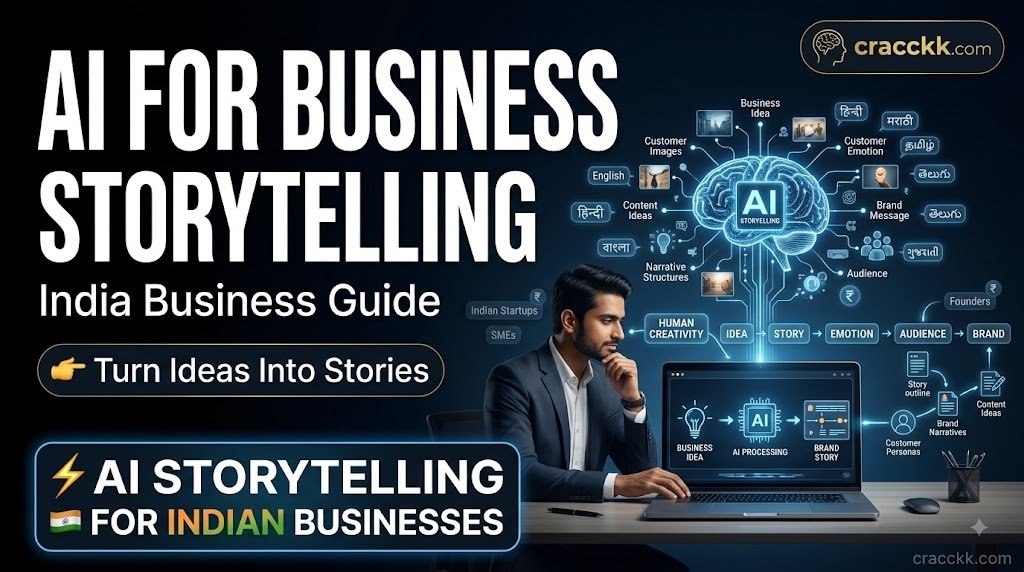
How to Use AI for Business Storytelling in India (2026 Guide)
How to Use AI for Business Storytelling in India
Introduction
When Ananya launched her handmade candle business in Hyderabad, she believed one thing would make customers choose her products over hundreds of competitors.
Better quality.
She spent months perfecting fragrances, packaging, and designs. Every candle was hand-poured using premium soy wax, and every order included a handwritten thank-you note.
Yet sales barely moved.
Her Instagram posts looked like everyone else’s.
“New collection available.”
“Limited stock.”
“Order now.”
“Best scented candles.”
The products were good.
The marketing wasn’t memorable.
One day, a customer messaged her after placing an order.
“I bought your candle because I read the story about how your grandmother taught you to make fragrances when you were a child.”
That surprised her.
She realised customers weren’t buying candles.
They were buying the story behind them.
Instead of posting only product photos, she started sharing stories.
She talked about where her ideas came from.
She explained why she chose eco-friendly ingredients.
She introduced customers to the artisans helping her pack every order.
She even shared failures—the batches that didn’t work and the lessons she learned while building her business.
Engagement doubled within weeks.
Customers started commenting.
People shared her posts.
Repeat purchases increased because buyers felt connected to the brand rather than just the product.
The biggest surprise?
She didn’t write most of those stories herself.
She used AI.
Instead of staring at a blank screen wondering what to post, AI helped brainstorm story ideas, improve writing, create emotional hooks, adapt content for different platforms, and even turn customer reviews into compelling marketing stories.
Today, this is exactly how many successful businesses create content.
AI isn’t replacing human storytelling.
It’s helping businesses tell better stories, more consistently, and in far less time.
That’s important because people rarely remember advertisements.
They remember stories.
Customers don’t connect with lists of features.
They connect with emotions, experiences, challenges, and transformations.
Whether you’re selling clothing, software, coaching, restaurants, jewellery, consulting, or home décor, your story often becomes your biggest competitive advantage.
The challenge is consistency.
Most business owners know storytelling works, but they struggle to come up with fresh ideas every week. Between running the business, serving customers, managing employees, and handling operations, writing engaging stories usually falls to the bottom of the priority list.
That’s where AI changes everything.
Today’s AI storytelling tools can generate content ideas, write first drafts, improve emotional impact, adapt stories for different audiences, create social media posts, build email campaigns, and even help develop an entire brand voice.
Instead of replacing creativity, AI becomes your creative partner.
In this guide, we’ll explore the best ways Indian businesses can use AI for storytelling in 2026, the tools that make it possible, practical examples, common mistakes to avoid, and a step-by-step framework for creating stories that customers actually remember.
Whether you’re a startup, freelancer, local business, e-commerce brand, or established company, you’ll discover how AI can help you create authentic stories that build trust, strengthen your brand, and drive long-term growth.
Why Storytelling Is More Important Than Ever in 2026
Customers today are surrounded by advertisements everywhere they look. They scroll past hundreds of social media posts, watch countless video ads, receive promotional emails, and browse dozens of websites every day.
Most of that content is forgotten within seconds.
What people remember are stories.
This is the difference between a generic ad and a compelling story. A compelling story creates a set of emotions that a basic list of features of a product can’t.
That’s why some brands develop loyal communities while others compete only on price.
The challenge for most businesses isn’t understanding the importance of storytelling—it’s creating fresh, engaging stories consistently.
Writing meaningful content every week requires time, creativity, and planning. Between managing customers, operations, and sales, many business owners run out of ideas or resort to repetitive promotional posts.
AI solves this problem.
Modern AI storytelling tools can brainstorm content ideas, build story outlines, improve emotional impact, rewrite dull copy, generate headlines, adapt stories for different platforms, and even help businesses develop a consistent brand voice.
Instead of replacing your experiences, AI helps you communicate them more effectively.
Who Should Use AI Storytelling?
AI storytelling isn’t just for professional writers or marketing agencies.
Any business that wants customers to remember its brand can benefit.
These tools are especially useful for:
- Small businesses
- E-commerce brands
- Coaches and consultants
- Marketing agencies
- SaaS companies
- Restaurants and cafés
- Real estate businesses
- Healthcare clinics
- Educational institutions
- Freelancers and creators
Whether you’re writing Instagram captions, email newsletters, website copy, LinkedIn posts, YouTube scripts, or customer success stories, AI helps turn ordinary information into engaging narratives.
Why Stories Sell Better Than Features
Imagine two businesses selling the same handmade leather wallet.
The first says:
“Premium genuine leather wallet. RFID protection. Available in three colours.”
The second says:
“Every wallet is handcrafted by artisans who’ve spent over twenty years perfecting traditional leather craftsmanship. Each stitch is carefully finished by hand before the wallet reaches your doorstep.”
Both describe the same product.
Only one tells a story.
Customers rarely remember specifications, but they remember people, experiences, challenges, and transformations.
Stories create trust.
Trust creates sales.
This is why businesses that consistently tell authentic stories often outperform competitors with larger advertising budgets.
AI helps speed up that process without removing the human element that makes storytelling powerful.
🥇 1 — ChatGPT
Best For: Creating brand stories, social media content, blog articles, email campaigns, and marketing copy.
Free Plan: Yes
Paid From: ChatGPT Plus for advanced models
Difficulty: ⭐ Very Easy
When it comes to AI storytelling, ChatGPT is one of the most versatile tools available.
Instead of simply generating paragraphs of text, ChatGPT helps businesses structure stories that capture attention, build emotion, and guide readers toward action.
You can ask it to create:
- Founder stories
- Customer success stories
- Product launch stories
- Brand origin stories
- Social media storytelling posts
- Website copy
- Email marketing campaigns
- Video scripts
- Case studies
One of its biggest strengths is adaptability.
For example, a bakery can ask ChatGPT to write an Instagram story explaining why it starts baking bread before sunrise every morning.
A software company can transform technical features into stories showing how customers solve real business problems.
A clothing brand can turn a product launch into a behind-the-scenes journey from design sketch to finished garment.
Instead of writing everything from scratch, business owners receive a solid first draft that they can personalise with their own experiences and brand voice.
Example Prompt
“Write an emotional LinkedIn story about how I started my digital marketing agency after losing my corporate job. Make it inspirational, authentic, and end with a lesson for entrepreneurs.”
Providing context like this allows ChatGPT to create stories that feel personal rather than generic.
Key AI Features
- Brand storytelling
- Social media storytelling
- Founder story creation
- Customer success stories
- Blog and email writing
- Video script generation
- Tone and style adjustment
- Story brainstorming
For businesses looking to improve their content marketing, ChatGPT is the easiest and most powerful AI storytelling tool available in 2026. It helps turn everyday business experiences into compelling stories that build trust and strengthen customer relationships.
🥈 #2 — Claude
Best For: Long-form storytelling, brand messaging, thought leadership, and emotionally engaging business content.
Free Plan: Yes
Paid From: Claude Pro for advanced usage
Difficulty: ⭐ Very Easy
While many AI writing tools are great at producing content quickly, Claude stands out for one important reason—it writes in a way that feels remarkably human.
For businesses that rely on storytelling to build trust, this makes a huge difference.
Whether you’re writing a founder’s journey, customer success story, case study, company mission, or LinkedIn article, Claude focuses on creating content that flows naturally instead of sounding like it was generated by AI.
One of its biggest strengths is handling long-form content. You can provide detailed background information about your company, customers, products, and goals, and Claude will organise everything into a compelling narrative without losing important details.
For example, imagine a startup launching an AI-powered healthcare platform.
Instead of simply listing features, Claude can create a story about a patient struggling to access quality healthcare, explain the challenges they faced, introduce the solution, and show the transformation after using the product.
This storytelling approach is far more memorable than traditional promotional content.
Claude is also excellent for refining existing writing. If you’ve already written a blog, website page, or company story, it can improve clarity, strengthen emotional impact, and make the content more engaging while preserving your original message.
Another advantage is its ability to maintain a consistent brand voice. Businesses can provide examples of previous content, and Claude will produce new stories that match the same tone and style.
How Businesses Use Claude
Many businesses use Claude to:
- Write founder stories.
- Create customer success stories.
- Develop brand messaging.
- Produce long-form blog articles.
- Write LinkedIn thought leadership posts.
- Create website “About Us” pages.
- Improve marketing copy.
- Develop investor presentations.
For brands that want thoughtful, authentic storytelling rather than fast promotional copy, Claude is an excellent choice.
Key AI Features
- Long-form story generation
- Brand voice consistency
- Customer case study creation
- Founder and company storytelling
- Website and About Us page writing
- Marketing copy refinement
- Thought leadership content
- AI-assisted editing and rewriting
For businesses focused on building trust through authentic storytelling, Claude is one of the strongest AI writing tools available in 2026. Its ability to produce detailed, natural, and emotionally engaging content makes it an excellent companion to any modern content marketing strategy.
🥉 3 — Gemini
Best For: Creating marketing stories, campaign ideas, product storytelling, and content tailored for Google’s ecosystem.
Free Plan: Yes
Paid From: Google AI Pro for advanced features
Difficulty: ⭐ Very Easy
If your business already uses Google Workspace or relies heavily on Google Search, Gemini is an excellent AI storytelling assistant. Developed by Google, Gemini helps businesses brainstorm ideas, create compelling marketing stories, and produce content for blogs, websites, emails, and social media.
One of Gemini’s biggest strengths is turning simple business information into engaging narratives. Instead of asking you to start with a blank page, it can take a few product details or customer insights and transform them into stories that are informative, relatable, and persuasive.
For example, if you own a furniture business, Gemini can create a story about how a handcrafted dining table becomes the centrepiece of family gatherings rather than simply describing its dimensions and materials. This emotional approach helps customers imagine the product in their own lives, making them more likely to buy.
Gemini is also particularly useful for businesses focused on SEO content marketing. It can generate blog outlines, FAQs, product descriptions, and storytelling-based articles that answer customer questions while naturally incorporating relevant keywords.
Another advantage is its seamless integration with Google Workspace. Teams can use Gemini to draft emails in Gmail, brainstorm ideas in Docs, summarise meetings, and collaborate on marketing campaigns without switching between multiple tools.
For businesses that regularly publish content across different channels, Gemini helps maintain a steady flow of fresh ideas while reducing the time spent planning and writing.
How Businesses Use Gemini
Many businesses use Gemini to:
- Write brand and product stories.
- Create SEO-friendly blog articles.
- Develop Google Ads and marketing campaigns.
- Generate website content.
- Brainstorm social media ideas.
- Write promotional emails.
- Create customer education content.
- Develop content calendars.
By combining storytelling with Google’s AI capabilities, businesses can create content that’s both engaging for readers and optimised for search engines.
Key AI Features
- AI-powered story generation
- SEO content creation
- Blog and article writing
- Product storytelling
- Email and marketing copy generation
- Google Workspace integration
- Content brainstorming
- Campaign planning
For businesses looking to improve their content marketing while staying productive within Google’s ecosystem, Gemini is one of the best AI storytelling tools available in 2026. It combines creativity, SEO support, and productivity features into one easy-to-use platform, making it ideal for businesses of all sizes.
🏅 4 — Canva Magic Write
Best For: Creating visual brand stories, social media content, presentations, and marketing campaigns.
Free Plan: Yes
Paid From: ~₹500/month (Canva Pro)
Difficulty: ⭐ Very Easy
Storytelling isn’t limited to words anymore. In today’s digital world, customers often experience your brand through visuals before they read a single sentence. That’s why Canva Magic Write has become one of the most useful AI storytelling tools for businesses.
Built directly into Canva, Magic Write helps users generate compelling content while designing social media posts, presentations, flyers, brochures, email graphics, and marketing materials. Instead of switching between multiple apps to write copy and create designs, you can do everything in one place.
Imagine you’re launching a new skincare product.
Rather than designing a promotional graphic that simply says “Now Available”, Magic Write can generate a story explaining how the product was developed, the problem it solves, and the benefits customers can expect. You can then pair that story with professionally designed visuals inside Canva, creating content that’s both informative and visually engaging.
Canva also makes storytelling easier with thousands of templates designed for Instagram carousels, LinkedIn posts, Facebook ads, presentations, and product launches. AI helps generate headlines, captions, call-to-actions, and slide content, while Canva’s design tools bring those stories to life.
For businesses with small marketing teams, this combination saves hours of work and ensures every campaign maintains a professional appearance.
How Businesses Use Canva Magic Write
Many businesses use Canva Magic Write to:
- Create storytelling-based Instagram carousels.
- Design product launch campaigns.
- Write captions for Facebook, Instagram, and LinkedIn.
- Build presentations for clients and investors.
- Design brochures and marketing materials.
- Create promotional email graphics.
- Produce visual case studies and customer success stories.
Instead of creating content and designs separately, businesses can build complete storytelling campaigns within a single platform.
Key AI Features
- AI-generated marketing copy
- Story-based social media captions
- Presentation and slide writing
- AI headline and CTA generation
- Instagram carousel content creation
- Brand kit integration
- Thousands of professional design templates
- AI-powered visual storytelling
For businesses that rely heavily on visual marketing, Canva Magic Write is one of the best AI storytelling tools available in 2026. It combines AI writing with world-class design tools, making it easy to create stories that capture attention and strengthen your brand across every marketing channel
🏅 5 — Notion AI
Best For: Planning, organising, and creating consistent brand stories across teams.
Free Plan: Yes
Paid From: ~₹800/month
Difficulty: ⭐ Easy
Creating one great story is relatively easy. Creating meaningful stories every week for months is much harder.
That’s why many businesses struggle with content consistency.
Notion AI helps solve that problem by combining AI writing with content planning, project management, and collaboration. Instead of simply generating marketing copy, it helps businesses organise their storytelling strategy from idea to publication.
Imagine you’re planning your content for the next quarter.
Instead of wondering what to post every morning, you can build a content calendar inside Notion. AI can generate blog ideas, social media topics, customer success stories, founder updates, email campaigns, and product launch content based on your business goals.
This makes it easier to maintain a consistent publishing schedule without constantly starting from scratch.
Notion AI is also excellent for documenting your brand story.
You can store information about your company history, mission, customer personas, product benefits, tone of voice, and previous campaigns in one workspace. When creating new content, AI can use this information to generate stories that stay consistent with your brand identity.
For growing businesses with multiple employees, this consistency is invaluable. Everyone—from marketers to sales teams—can create content that sounds like it’s coming from the same brand.
Another advantage is collaboration.
Marketing teams can brainstorm ideas together, assign writing tasks, collect feedback, and refine stories inside a single workspace. Instead of juggling multiple documents and messaging apps, everything stays organised in one place.
How Businesses Use Notion AI
Businesses commonly use Notion AI to:
- Plan monthly content calendars.
- Brainstorm storytelling ideas.
- Write blog outlines.
- Create social media campaigns.
- Build customer case studies.
- Organise brand guidelines.
- Develop email marketing campaigns.
- Manage collaborative content projects.
By combining AI writing with project management, Notion AI helps businesses publish better content more consistently.
Key AI Features
- AI-powered content generation
- Story and campaign brainstorming
- Blog and article outlining
- Content calendar planning
- Meeting summaries
- Brand documentation
- Team collaboration
- Workflow and project management
For businesses producing content regularly, Notion AI is much more than an AI writing assistant. It’s a complete content planning system that helps teams organise ideas, maintain a consistent brand voice, and publish engaging stories without the chaos of managing multiple tools.
Quick Comparison — Which AI Storytelling Tool Should You Choose?
Choosing the right AI storytelling tool depends on how your business creates content. Some platforms are designed for writing, while others focus on planning, visual storytelling, or maintaining a consistent brand voice.
| Business Need | Best Tool | Why It Stands Out | All-in-One Storytelling | ChatGPT | Creates blogs, emails, social media posts, founder stories, and marketing campaigns with ease. |
|---|---|---|
| Long-Form Brand Content | Claude | Produces natural, emotionally engaging stories perfect for blogs, case studies, and thought leadership. |
| SEO & Marketing Content | Gemini | Excellent for Google-friendly content, blog ideas, and product storytelling. |
| Visual Storytelling | Canva Magic Write | Combines AI writing with professional design for social media, presentations, and marketing materials. |
| Content Planning & Collaboration | Notion AI | Helps teams organise storytelling ideas, content calendars, and brand messaging in one workspace. |
Every tool has a different strength. If you’re looking for a versatile AI assistant that can handle almost any storytelling task, ChatGPT is the best place to start. It can generate everything from Instagram captions and email campaigns to founder stories and long-form blog posts.
If your business focuses on publishing detailed articles or building thought leadership, Claude delivers some of the most natural and human-like writing available. Businesses prioritising SEO and content marketing will appreciate Gemini, especially if they already use Google Workspace.
For brands that rely heavily on visual content, Canva Magic Write combines storytelling with professional design, making it ideal for social media and presentations. Meanwhile, Notion AI is perfect for businesses that need to organise ideas, maintain a consistent brand voice, and manage content production across multiple team members.
Rather than relying on a single platform, many successful businesses combine several AI tools. For example, you might use ChatGPT to draft a story, Claude to refine the tone, Canva Magic Write to design the visuals, and Notion AI to schedule and manage your content calendar. This workflow saves time while ensuring every piece of content stays engaging, professional, and consistent.
How to Use AI for Business Storytelling
Having the right AI tool is only half the equation. The real advantage comes from knowing how to turn everyday business moments into stories that customers remember.
Here’s a simple five-step framework that businesses of any size can follow.
Step 1: Find Stories Hidden in Your Business
Many business owners believe they don’t have interesting stories to tell.
In reality, they’re surrounded by them every day.
Think about:
- Why you started your business.
- A customer’s success after using your product.
- A challenge your team recently solved.
- How a product is designed or manufactured.
- Lessons learned from a failure.
- Behind-the-scenes moments.
- Employee achievements.
- Customer testimonials.
These experiences are often far more engaging than promotional posts because they’re authentic.
Use AI to brainstorm additional angles you may not have considered.
Step 2: Let AI Create the First Draft
Once you’ve chosen a story, use AI to build the foundation.
Instead of spending an hour writing from scratch, provide AI with the key details and let it generate the first version.
For example:
“Write a LinkedIn post about how our small bakery wakes up at 4 AM every morning to bake fresh bread. Make it emotional, inspiring, and end with a lesson about consistency.”
Within seconds, you’ll have a structured story that’s ready to personalise.
Remember, AI should create the draft—not the final version.
Step 3: Add Your Human Experience
This is where many businesses go wrong.
Publishing AI-generated content without editing often results in generic stories that sound like everyone else’s.
Instead, add details only you know.
Mention the customer’s name (with permission), the conversation that inspired the product, the mistake your team made, or the emotion you felt during an important milestone.
These personal details transform ordinary content into memorable storytelling.
AI gives you speed.
Your experiences give the story authenticity.
Step 4: Adapt One Story for Multiple Platforms
One good story shouldn’t only appear once.
AI can quickly rewrite it for different platforms.
For example, a single founder story can become:
- A LinkedIn article.
- An Instagram carousel.
- A Facebook post.
- An email newsletter.
- A blog article.
- A YouTube script.
- An X (Twitter) thread.
Instead of creating seven different pieces of content, you’re simply adapting one story to suit different audiences.
Step 5: Measure What Resonates
Not every story will perform equally well.
Pay attention to metrics like:
- Comments and shares.
- Time spent reading.
- Email open rates.
- Website traffic.
- Leads generated.
- Customer replies.
Use those insights to identify which stories resonate most with your audience.
The businesses that improve their storytelling the fastest aren’t necessarily the best writers—they’re the ones that consistently test, learn, and refine their content.
Frequently Asked Questions
Q: Can AI replace human creativity in storytelling?
No. AI is designed to assist creativity, not replace it. It can generate ideas, structure stories, improve writing, and overcome writer’s block, but the most memorable stories still come from real experiences, emotions, and customer interactions. Think of AI as your creative partner rather than your storyteller.
Q: Which AI storytelling tool is best for beginners?
ChatGPT is the best starting point for most businesses. It’s easy to use, supports everything from blog writing and email campaigns to social media storytelling, and requires very little technical knowledge.
Q: Can AI help me write stories for social media?
Absolutely. AI can create Instagram captions, LinkedIn posts, Facebook updates, X (Twitter) threads, YouTube scripts, and even complete content series. You simply provide the topic, target audience, and desired tone, and AI generates a strong first draft that you can personalise.
Q: Is AI-generated storytelling good for SEO?
Yes—when used correctly. AI can help create SEO-friendly blog posts, FAQs, product stories, and website content that naturally include relevant keywords. However, you should always review and personalise the content to ensure it reflects your brand’s expertise and provides genuine value to readers.
Q: Can AI help tell customer success stories?
Yes. AI can transform customer testimonials, reviews, and case studies into compelling success stories. Simply provide the customer’s challenge, your solution, and the results achieved, and AI can organise the information into a clear, engaging narrative.
Q: How often should businesses publish storytelling content?
Consistency matters more than frequency. For most businesses, publishing two to four storytelling posts each week, one detailed blog article each month, and a regular email newsletter is enough to build trust and keep audiences engaged without sacrificing quality.
The Bottom Line
People rarely remember advertisements.
They remember stories.
Whether it’s the journey that inspired your business, a customer’s transformation, a behind-the-scenes moment, or the lesson learned from overcoming a challenge, storytelling helps customers connect with your brand on a deeper level.
AI makes this process easier than ever.
Instead of struggling to come up with new ideas or spending hours writing from scratch, modern AI tools can help you brainstorm topics, draft compelling stories, refine your messaging, adapt content for different platforms, and maintain a consistent brand voice—all while saving valuable time.
For most businesses, ChatGPT is the best all-round storytelling assistant. Claude excels at long-form and emotionally engaging content, Gemini is ideal for SEO-focused marketing, Canva Magic Write combines storytelling with professional design, and Notion AI helps teams plan and manage content more efficiently.
The businesses that stand out in 2026 won’t necessarily have the biggest marketing budgets.
They’ll be the ones telling the most authentic stories.
Your Action Plan
- ✅ Identify the stories already hidden within your business.
- ✅ Use AI to brainstorm ideas and create the first draft.
- ✅ Add your own experiences, personality, and customer insights.
- ✅ Repurpose one story across multiple marketing channels.
- ✅ Publish consistently and refine your storytelling based on audience engagement.
The best story your business can tell is the one that’s real. Let AI help you tell it more effectively—but always let your experience, values, and personality lead the conversation.
How are you using AI to tell your brand’s story? Share your experience in the comments below.
Published by Crackkk
Helping Indian businesses, entrepreneurs, and creators grow with practical AI guides, software reviews, and actionable digital marketing insights.
Explore more AI tools, business strategies, and technology guides at Crackkk.com.