AI Tools for Salon and Beauty Businesses
Introduction
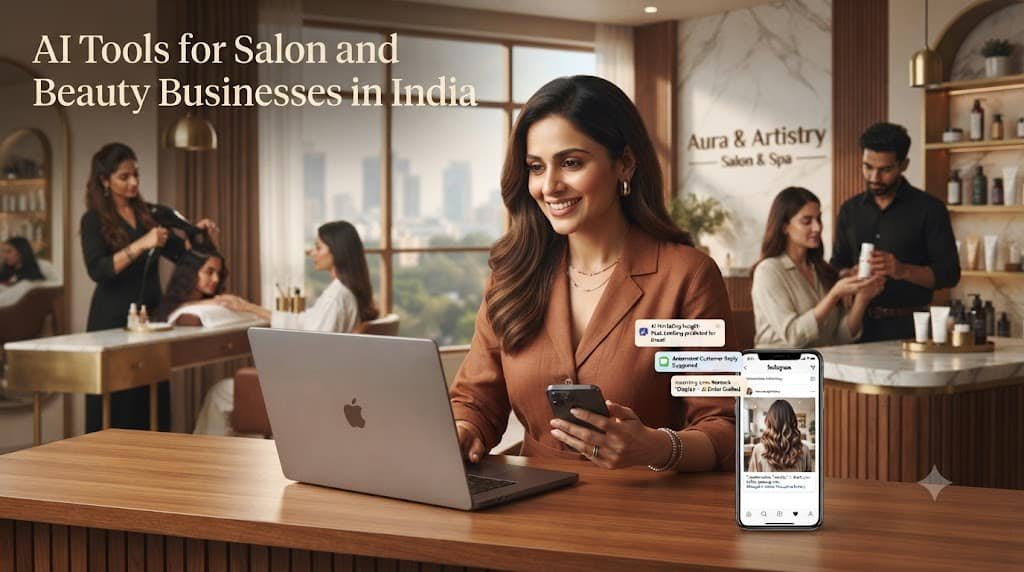
Running a salon or beauty business involves much more than providing haircuts, skincare, makeup, or other beauty services. Salon owners also have to manage appointments, answer customer questions, create social media content, follow up with clients, promote offers, and keep existing customers coming back. This is why more owners are turning to AI tools for salon and beauty businesses to lighten the daily workload.
For many small salons and beauty businesses, these tasks can take almost as much time as the actual services.
This is where artificial intelligence can help.
Today, AI tools for salon and beauty businesses can assist with everything from creating Instagram content and answering customer messages to automating marketing and managing appointments. The goal isn’t to replace hairstylists, beauticians, makeup artists, or salon staff. Instead, AI can handle repetitive digital tasks so the team can spend more time with customers.
In this guide, we’ll cover how salons can use AI, the best AI tools for salon and beauty businesses, and how a small salon can gradually introduce AI without unnecessarily complicating operations.
How AI Tools for Salon and Beauty Businesses Are Changing the Industry
The beauty industry has always depended heavily on personal interaction. Customers want recommendations, consultations, personalised services, and a good experience.
AI doesn’t change that human element. Instead, it can improve the work happening behind the scenes. Many of the AI tools for salon and beauty businesses on the market today were built specifically to handle this behind-the-scenes work.
For example, imagine a salon owner who receives dozens of Instagram messages every day.
Some customers ask:
“What is the price of hair colouring?” “Do you have appointments tomorrow?” “How much does bridal makeup cost?” “What time do you open?” “Can I book a facial?” “Where are you located?”
Answering these questions individually can take a lot of time.
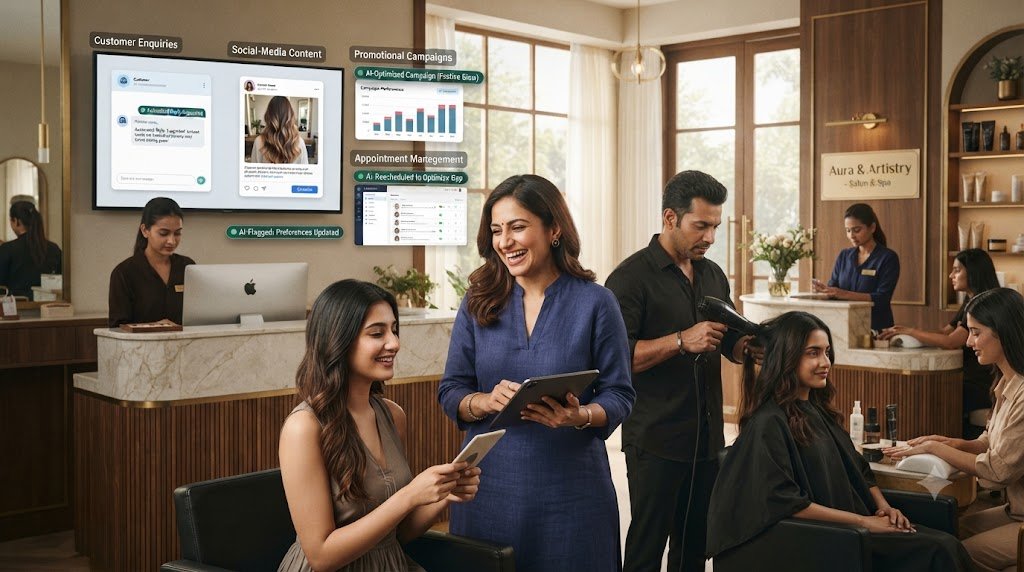
With AI-powered chat and automation tools, many routine questions can receive immediate responses. Staff can then concentrate on customers who need personal assistance.
AI can also help salons create social media posts, write captions, generate promotional ideas, analyse customer information, prepare marketing campaigns, and organise repetitive workflows.
The result is a business where technology handles some repetitive digital tasks while people continue to handle the services and relationships that require a human touch.
Best Uses of AI Tools for Salon and Beauty Businesses
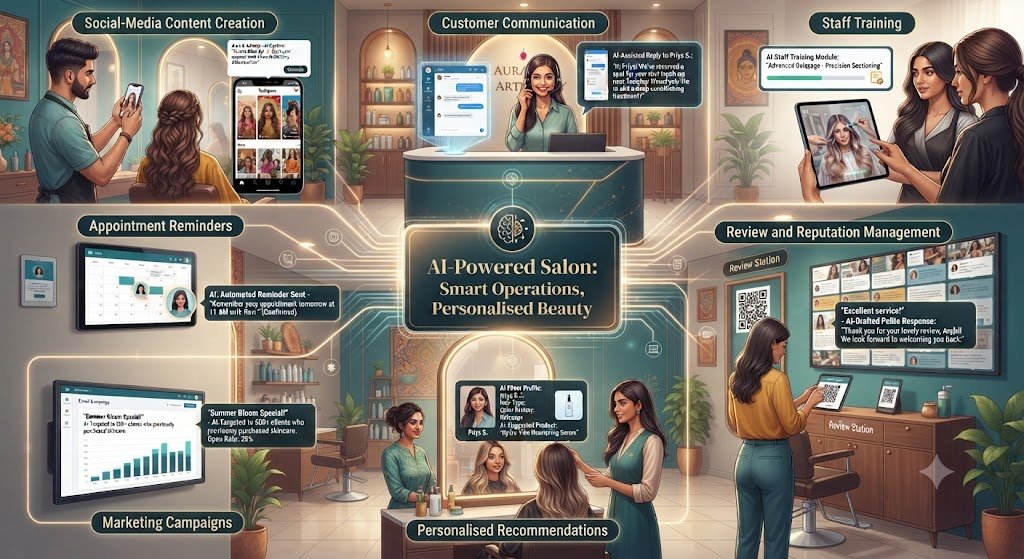
There isn’t one single way to use AI in a salon. Different businesses can use it for different problems. The list below covers the most practical uses of AI tools for salon and beauty businesses today.
Here are some practical applications.
- Social Media Content Creation
Instagram is particularly important for salons and beauty businesses because the industry is highly visual. This is one of the most popular entry points for AI tools for salon and beauty businesses.
A salon can use AI to generate:
- Instagram captions
- Reel ideas
- Content calendars
- Promotional posts
- Beauty tips
- Before-and-after post ideas
- Festival campaigns
- Service descriptions
- Educational content
Instead of spending an hour trying to decide what to post, a salon owner can ask an AI tool to generate several ideas based on the salon’s services.
For example, a salon offering hair colouring could create a weekly content plan around hair-care tips, colour trends, customer transformations, FAQs, and promotional offers.
- Customer Communication
Customer communication is another area where AI tools for salon and beauty businesses can save time.
AI-powered chatbots and automation platforms can answer frequent questions and guide customers toward the right information.
For example:
Customer: “Do you provide bridal makeup?”
AI assistant: “Yes. We offer bridal makeup packages. Would you like to see the available packages and pricing?”
The customer can then be directed to a booking system or a member of the salon team.
This doesn’t mean every conversation should be automated. Complex questions and personal consultations should still be handled by staff.
- Appointment Reminders
Missed appointments can cost salons both time and money.
Automated messages can remind customers about upcoming appointments and encourage them to confirm, reschedule, or contact the salon.
This reduces the amount of manual follow-up required from reception staff, which is why appointment reminders remain one of the simplest AI tools for salon and beauty businesses to set up.
- Marketing Campaigns
AI can help salon owners plan campaigns around events and seasons.
Examples include:
- Valentine’s Day offers
- Wedding season packages
- Diwali promotions
- Eid beauty packages
- Summer skincare campaigns
- Festive makeup packages
- Hair-care packages
- Customer loyalty campaigns
Instead of starting from a blank page, the owner can use AI to generate campaign concepts, promotional copy, social-media ideas, and email or WhatsApp messages. Seasonal campaigns are where many salons first see the value of AI tools for salon and beauty businesses.
- Personalised Recommendations
Beauty businesses have many customers who have different preferences and needs. Personalisation is one area where AI tools for salon and beauty businesses genuinely stand out.
AI can help organise customer information and provide staff with useful context.
For example, a salon’s records might show that a customer regularly books a particular service. The business could use this information to send a relevant reminder or promotion.
However, salons should handle personal and sensitive customer information carefully and follow applicable privacy requirements.
- Review and Reputation Management
Online reviews can influence whether potential customers decide to visit a salon. Reputation management is a quieter but valuable use case for AI tools for salon and beauty businesses.
AI can help businesses organise reviews, identify recurring feedback, and draft professional responses.
For example, if customers repeatedly mention long waiting times, the salon owner may identify it as an operational issue that needs attention.
AI can help summarise this feedback, but the final business decision should remain with the owner.
- Training and Staff Support
AI can also help salon owners prepare training material, another underrated use of AI tools for salon and beauty businesses.
It can create:
- Staff training guides
- Customer-service scripts
- Product knowledge quizzes
- New employee onboarding documents
- Service checklists
- Frequently asked questions
This becomes useful when a salon is hiring new staff or expanding to multiple locations.
Best AI Tools for Salon and Beauty Businesses
ChatGPT
ChatGPT can act as a general-purpose AI assistant for a salon or beauty business, and it remains one of the most flexible AI tools for salon and beauty businesses of any size.
A salon owner can use it to brainstorm marketing campaigns, write social-media captions, create customer-service responses, develop content calendars, write service descriptions, and prepare internal documents.
For example, a salon owner could ask:
“Create 15 Instagram Reel ideas for a salon targeting women aged 20–35 interested in hair colouring.”
The tool can then generate a list of ideas that the salon can refine.
ChatGPT can also help with administrative writing, promotional campaigns, staff training material, and business brainstorming.
Best for: Content creation, marketing ideas, customer-response drafts, business planning, staff documentation.
Its biggest advantage is flexibility: it can assist with many different tasks rather than performing only one function.
Canva AI
Canva is particularly useful for beauty businesses because visual content is central to salon marketing.
Canva’s AI features can help businesses create and modify designs for social media, promotions, posters, menus, presentations, and other marketing materials.
A salon could create a promotional design for a new facial package, generate an Instagram post about hair-care tips, or prepare a festive offer campaign.
For a small business without a dedicated graphic designer, this can make content creation considerably easier.
Best for: Instagram posts, reels and social content, promotional graphics, offer posters, service menus, marketing materials.
The main part is to maintain consistent branding rather than generating completely different-looking designs for every post.
ManyChat
ManyChat can help salons automate conversations and marketing through supported messaging platforms.
For a beauty business, this can be used for asking questions, collecting enquiries, sending information, and guiding potential customers through a conversation.
For example, someone could respond to a salon’s Instagram promotion and receive an automated message asking what service they are interested in.
The conversation can then guide them toward booking or connecting with the salon team.
Best for: Instagram automation, customer enquiries, lead generation, FAQ automation, marketing workflows.
For salons receiving large numbers of social-media enquiries, automation can reduce repetitive conversations.
Fresha
Fresha is designed specifically for beauty and wellness businesses rather than being a general-purpose AI assistant.
It can help businesses manage areas such as appointments, clients, services, payments, and other operational processes.
For salons, having these functions connected in one system can make day-to-day management easier.
Instead of relying on separate spreadsheets, notebooks, messaging apps, and booking systems, a salon can centralise important operational information.
Best for: Appointment management, client management, salon operations, booking workflows, beauty and wellness businesses.
The exact features and availability can vary by market and plan, so businesses should check the current offering before choosing it.
Predis.ai
Predis.ai focuses heavily on social-media content creation and marketing.
For salons, it can help generate content ideas, captions, creatives, and social-media material based on a business’s marketing requirements.
This is useful for salons that know they need to post regularly but struggle to maintain a consistent content schedule.
For example, a salon could create a monthly content plan covering hairstyles, skincare tips, customer transformations, seasonal offers, and educational posts.
Best for: Social-media marketing, content ideas, captions, promotional content, content planning.
The salon should still review AI-generated content before publishing it to ensure that prices, services, offers, and claims are accurate.
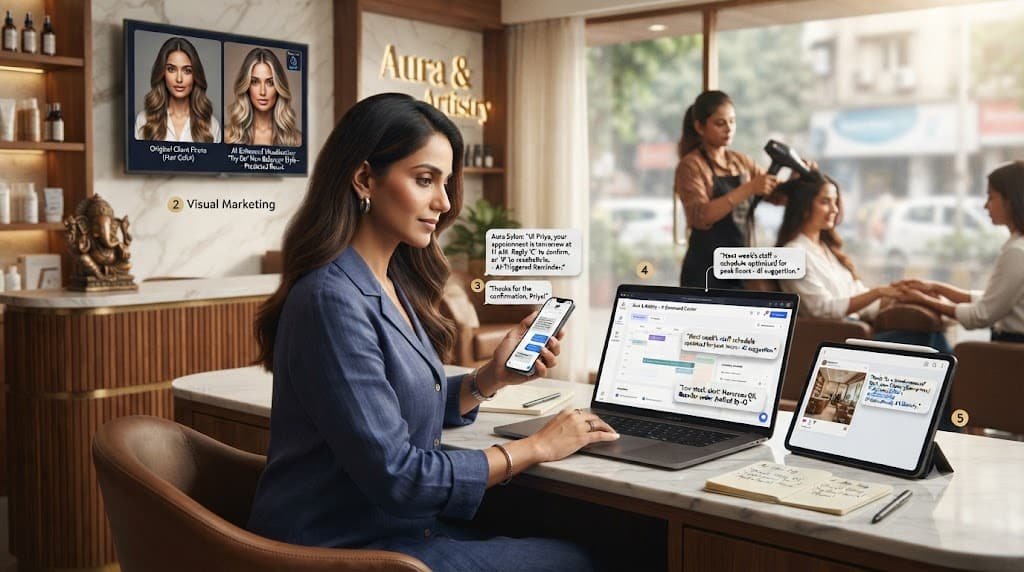
Comparison Table
| AI Tool | Best For | Key Features | Ease of Use | Ideal Use Case |
|---|---|---|---|---|
| ChatGPT | General AI assistance | Writing, ideas, planning, customer responses | Easy | Most salon tasks |
| Canva AI | Visual marketing | Designs, social posts, promotional creatives | Easy | Instagram-focused salons |
| ManyChat | Customer automation | Messaging, lead capture, automated conversations | Medium | Salons with many enquiries |
| Fresha | Salon management | Booking, client management, operations | Easy–Medium | Salon and wellness businesses |
| Predis.ai | Social marketing | Content generation, captions, creatives | Easy | Social-media marketing |
The right choice depends on the salon’s biggest problem, and the table above should make it easier to compare AI tools for salon and beauty businesses at a glance.
A salon struggling with content may benefit most from Canva AI or Predis.ai. A salon receiving hundreds of repetitive enquiries may benefit more from ManyChat. A business looking for operational management should examine salon-management platforms such as Fresha.
How to Slowly Implement AI Tools for Salon and Beauty Businesses
One of the biggest mistakes a small business can make is trying to introduce too many AI tools for salon and beauty businesses at once.
You don’t need ten AI systems on the first day.
Start with one repetitive problem.
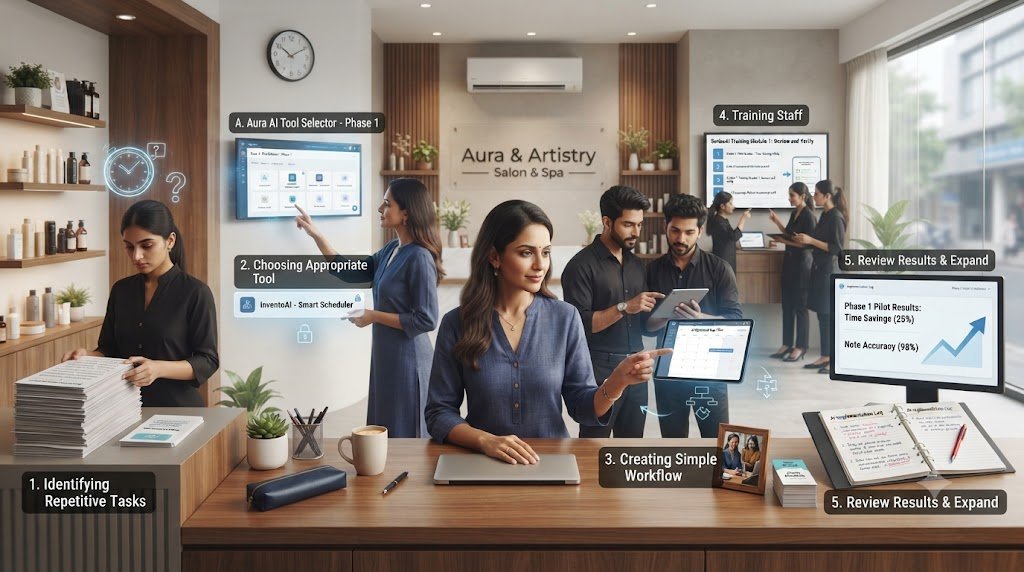
Step 1: Identify Your Biggest Time-Wasting Task
Look at what employees repeatedly do every day.
Is it:
- Answering the same customer questions?
- Creating Instagram posts?
- Sending reminders?
- Writing promotional messages?
- Organising customer information?
- Preparing staff documents?
Choose one.
Step 2: Choose One Tool
Select a tool specifically for that problem — not every one of the available AI tools for salon and beauty businesses needs to be adopted at once.
For example, if social-media content takes too much time, start with Canva AI or Predis.ai.
If repetitive Instagram enquiries are the problem, investigate ManyChat.
Step 3: Create a Simple Workflow
Don’t try to automate an entire business.
Start with something simple.
For example: customer enquiry, automated initial response, service information, booking link, human assistance when required.
A simple workflow is easier to monitor and improve.
Step 4: Train Your Staff
Employees should understand what the AI tool does and, equally importantly, what it doesn’t do.
Make clear which messages can be automated and which situations require a human response.
Step 5: Review the Results
After several weeks, compare the process with the old method.
Look at:
- Time saved
- Number of enquiries handled
- Appointment conversions
- Content output
- Customer responses
- Staff workload
If the tool genuinely helps, expand its use.
Step 6: Add Another AI Workflow
Once one workflow works reliably, introduce another.
A salon could eventually have a system where AI creates content, social media generates enquiries, automation handles initial questions, the booking system manages appointments, and staff provide the actual service.
The objective isn’t maximum automation.
The objective is better operations with less unnecessary manual work.
The Downsides of Using AI Tools for Salon and Beauty Businesses
So far, we’ve talked mostly about the upside. But AI tools for salon and beauty businesses come with real trade-offs that owners should weigh before adopting them.
It can feel impersonal. Beauty services are built on personal trust. A customer who gets an automated reply to a sensitive question, or feels like they’re talking to a bot instead of a person, may come away with a worse impression of the salon.
Mistakes can reach customers directly. AI-generated captions, prices, or promotional details are sometimes wrong or outdated. If nobody checks the output before it’s posted or sent, incorrect information can go straight to customers.
It costs money and time to set up properly. Many AI tools for salon and beauty businesses look simple on the surface but need real setup — writing FAQs, connecting booking systems, training staff — before they actually save time. Done poorly, a tool can create extra work rather than removing it.
Data privacy is a genuine concern. Salons hold sensitive customer information, including contact details, preferences, and sometimes health-related notes for treatments. Feeding this into AI tools without understanding their privacy policies can create compliance and trust risks.
Over-automation can backfire. A salon that automates too much, too fast, risks customers feeling handled rather than cared for. Complex requests, complaints, or emotionally sensitive conversations still need a human response.
Results aren’t guaranteed. AI can help with content, marketing, and admin work, but it doesn’t fix an underlying problem with pricing, service quality, or customer experience. A salon expecting AI alone to bring in more business may be disappointed.
None of this means AI tools for salon and beauty businesses aren’t worth using — it means they work best as a support system, not a replacement for careful oversight and genuine human interaction.
What Should Salons Be Careful About When Using AI?
AI can be useful, but it isn’t perfect. Not every one of the AI tools for salon and beauty businesses on the market today is trustworthy with sensitive information.
A salon should review AI-generated information before sending it to customers.
This is especially important for:
- Prices
- Appointment availability
- Promotions
- Product claims
- Beauty or skincare advice
- Health-related claims
- Customer information
AI should also not be trusted blindly with sensitive customer data. Businesses should understand the privacy policies of the tools they use and avoid sharing information unnecessarily.
Most importantly, automation should not make a salon feel impersonal.
Customers visit beauty businesses for human interaction and expertise. AI should support that experience rather than remove it.
FAQs
Can AI replace salon employees?
No. AI can automate certain repetitive digital and administrative tasks, but services such as hairstyling, beauty treatments, consultations, makeup application, and customer relationships require human skills and judgement.
Is AI useful for a small salon?
Yes. Small salons can benefit from AI because they often have limited staff and resources. Even automating one task, such as social media content or repetitive customer enquiries, can save time.
Can AI help salons get more customers?
AI can support marketing, content creation, lead generation, customer communication, and follow-ups. However, using AI does not guarantee more customers. Results depend on the quality of the salon’s offer, marketing, service, pricing, location, and customer experience.
Can AI create Instagram posts for a salon?
Yes. Tools such as Canva AI and Predis.ai can assist with creating social media content. The salon should review the content before publishing it.
Can AI handle customer enquiries?
AI-powered messaging and chatbot systems can handle many routine questions. More complicated questions should be transferred to a human team member.
How much does AI cost for a salon?
The cost depends on the tools and plans selected. Some AI products offer free options, while advanced features may require paid subscriptions. A salon should compare the cost against the amount of time or operational work the tool is expected to save.
What AI tool should a salon use first?
There isn’t one universal starting point. The best starting tool depends on the salon’s biggest operational problem. A salon focused on social media might start with a content tool, while one struggling with repetitive enquiries might start with a messaging automation platform.
Is AI difficult for salon staff to learn?
Many modern AI tools are designed for non-technical users. Staff can usually start with simple workflows and gradually learn more advanced features as they become comfortable.
The Bottom Line
AI tools for salon and beauty businesses aren’t about turning a salon into a robot-operated business.
It’s about removing repetitive work.
A salon owner shouldn’t have to spend hours writing captions when an AI assistant can help create them. Reception staff shouldn’t have to answer the same basic question dozens of times if automation can provide the initial information. Marketing shouldn’t have to start from a blank page every week when AI can help generate ideas.
At the same time, the human side of a beauty business remains essential.
Customers still want skilled hairstylists, experienced beauticians, talented makeup artists, helpful receptionists, and personalised recommendations.
The most practical approach is therefore to combine the efficiency of AI tools for salon and beauty businesses with genuine human expertise.
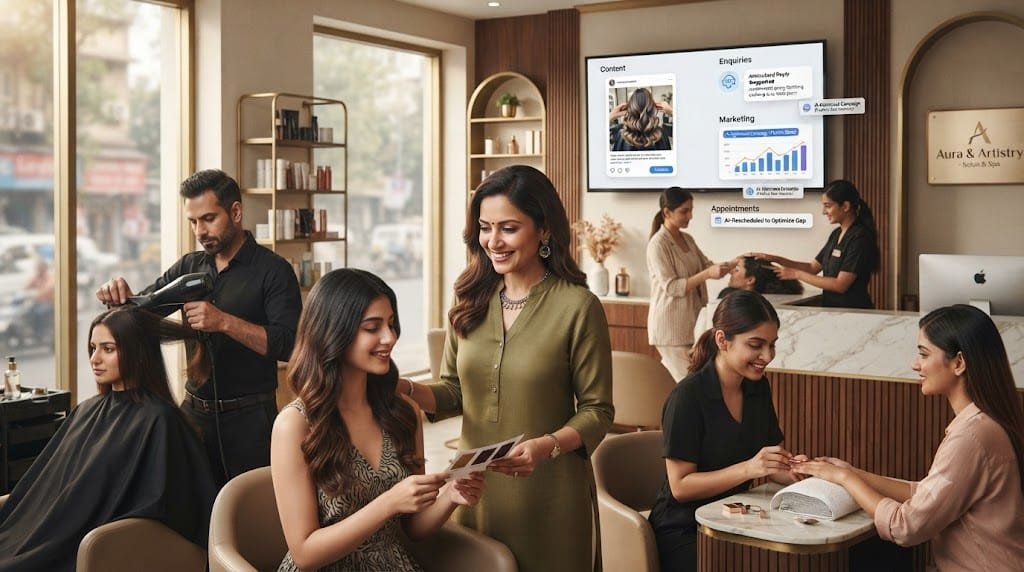
Start with one repetitive task. Choose one appropriate tool. Build a simple workflow. Measure the results. Then expand.
For a salon that adopts AI tools for salon and beauty businesses thoughtfully, the biggest benefit may not be replacing people — it may be giving those people more time to do what they do best: take care of customers.
Published by Crackk.com
Crackk.com covers artificial intelligence, AI tools, automation, technology, and practical AI applications for businesses, helping founders and professionals understand how to use emerging technology effectively in real-world work.