
AI Tools for Textile Businesses in India
Introduction
Ramesh runs a mid-sized textile business in Surat. On a typical morning, he’s juggling a new design request from a retail buyer, customer enquiries on WhatsApp, an outdated product catalogue, an inventory count that never quite matches the ledger, a slipping production schedule, and suppliers waiting on callbacks. By the time he can think about marketing, the day is nearly over.
Ramesh’s situation isn’t unusual. Across India, textile and garment business owners spend a portion of their day chasing information and repeating the same answers, rather than designing or producing.
This is where AI tools for textile businesses in India are starting to make a practical difference. When Ramesh began experimenting, he found he could draft catalogue descriptions in minutes, get quick answers on trends, and let a chatbot handle repetitive WhatsApp queries so he could focus on sourcing and quality.
None of this replaced his designers, his production team, or his own judgement. It simply gave him back time.
Used properly, AI tools for textile businesses in India can save time, support better decision-making, improve marketing content, and streamline day-to-day workflows — without requiring a business to overhaul everything at once.
How AI Is Changing India’s Textile Industry
AI is being applied across nearly every stage of the textile and apparel value chain, though how deeply depends on the size and type of business. This is part of why AI tools for textile businesses in India look so different from one business to the next.
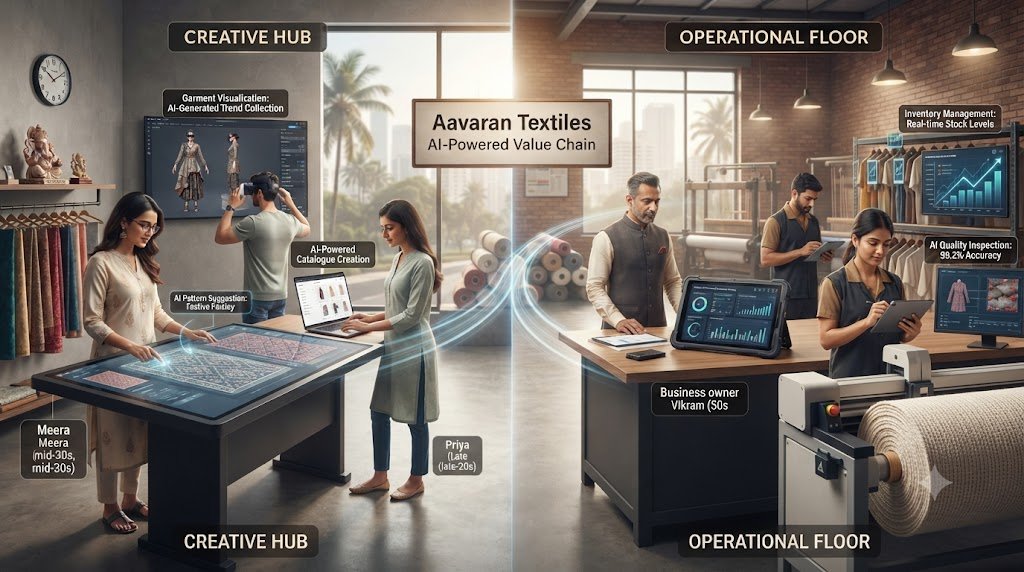
On the creative and business side, AI is helping with:
- Trend forecasting and design ideation
- Garment visualisation
- Catalogue creation
- Marketing and social media content
- Customer service and sales support
- Business reporting and sales analysis
On the industrial and operational side, AI is being used for:
- Production planning
- Quality inspection
- Predictive maintenance
- Demand forecasting and inventory management
- Sustainability and operational analysis
It helps to separate these two categories. Using AI to draft a product description is low-risk and available to almost any business. Deploying computer-vision quality inspection on a production line usually needs cameras, integration work, and a genuine manufacturing use case — not something a small workshop needs on day one.
India’s textile sector spans small family-run units and wholesalers, mid-sized manufacturers, and large export houses. The right entry point among AI tools for textile businesses in India depends on business size, existing workflows, data quality, budget, and the software already in use. There’s no single setup that fits everyone — the goal is matching the tool to the actual problem.
10 Ways Textile Businesses Can Use AI
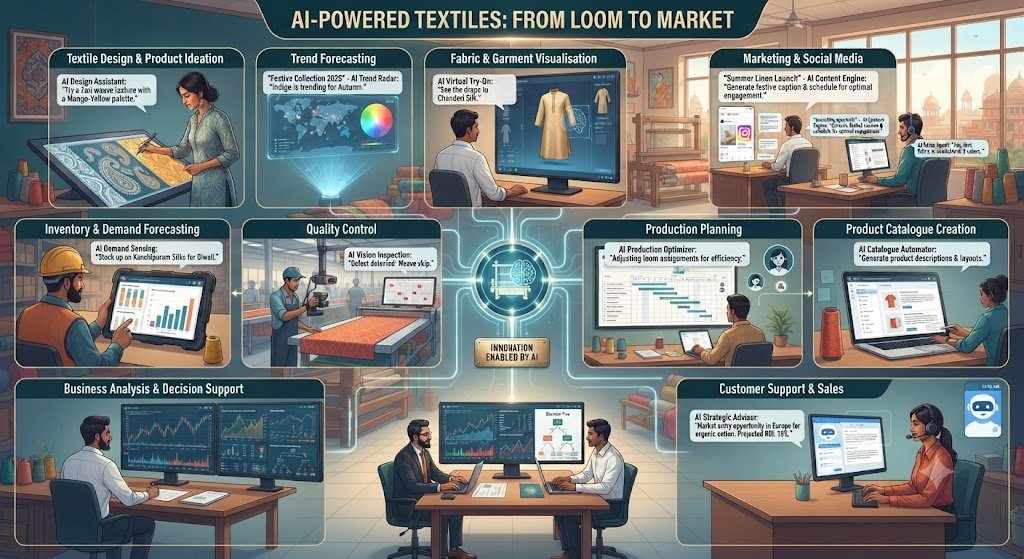
- Textile Design and Product Ideation
Generative AI can help brainstorm patterns, colour palettes, and design directions from a text description or reference image — one of the more creative uses of AI tools for textile businesses in India. A designer preparing a festive collection could generate several motif variations before briefing an in-house team, speeding up early brainstorming. The limitation: AI ideas still need a trained eye to refine and adapt to fabric behaviour before production.
- Trend Forecasting
AI-powered platforms analyse large volumes of fashion data to highlight emerging colours and preferences, which businesses can weigh alongside past sales when planning collections. A manufacturer could cross-check a colour story against current reports before bulk fabric orders. Forecasts are directional, not guarantees — regional Indian taste still needs local buyer feedback.
- Fabric and Garment Visualisation
AI and 3D tools can turn flat images or patterns into realistic garment renders on virtual models, letting a business preview a saree or kurta before a full physical sample. A wholesaler could visualise a design digitally for a buyer meeting instead of arranging a same-day shoot. Visualisation supports decisions but doesn’t fully replace physical sampling for fit and drape.
- Inventory and Demand Forecasting
AI can analyse historical sales, seasonality, and business data to estimate demand for specific products or fabrics, helping reduce overstocking or stockouts. This is one of the most measurable uses of AI tools for textile businesses in India, since the impact shows up directly in stock levels. A fabric wholesaler could flag which prints reliably sell out before the festive season and stock accordingly. Forecasts are only as reliable as the underlying sales data.
- Quality Control
Computer-vision inspection systems can be trained to spot fabric defects or stitching errors more consistently than manual spot checks alone. A garment factory could use one on a finishing line to catch issues before packing. This needs appropriate hardware and integration — it’s a manufacturing-floor solution, not a plug-and-play app for every business.
- Production Planning
AI can help analyse schedules, machine utilisation, and bottlenecks so managers can sequence orders more efficiently. A manufacturer juggling several export orders could identify which machines sit underused in a given week. The quality of the insight depends on how well production data is recorded to begin with.
- Marketing and Social Media
AI tools can generate captions, campaign ideas, product descriptions, and content calendars, making marketing one of the fastest-growing uses of AI tools for textile businesses in India. A boutique could draft a week of caption ideas for a new kurti collection instead of starting from a blank page each time. Output should still be checked for accuracy and brand tone before publishing. [Internal Link: AI Tools for Marketing]
- Product Catalogue Creation
AI can help draft product descriptions, structure catalogue layouts, and generate promotional images — a task where AI tools for textile businesses in India can save real time at scale. A wholesaler with hundreds of SKUs can use it to speed up writing consistent descriptions rather than drafting each one manually. Prices, fabric composition, and care instructions should always be verified before publishing.
- Customer Support and Sales
AI chatbots can handle repetitive questions about pricing, availability, and order status — a common first step for businesses exploring AI tools for textile businesses in India. Many Indian textile businesses run heavily on WhatsApp, and some AI tools support WhatsApp-based workflows — though not every tool integrates automatically, so this should be checked before choosing one. A retailer could automate “Is this saree available in blue?” while routing complex requests to staff.
- Business Analysis and Decision Support
AI assistants can summarise spreadsheets, analyse sales or inventory data, and help prepare reports — one of the less visible but genuinely useful AI tools for textile businesses in India. An owner could ask an AI assistant to summarise a month’s sales figures before presenting them to partners. Summaries should be checked against source data, especially for anything used in financial decisions.
Best AI Tools for Textile Businesses in India
ChatGPT
ChatGPT is a general-purpose AI assistant and one of the most flexible AI tools for textile businesses in India simply because it handles so many different tasks: drafting product descriptions and marketing copy, writing customer-response templates, competitor research, content calendars, supplier emails, business brainstorming, basic data analysis, and SOP documentation.
Example: A fabric exporter preparing for a trade fair could use ChatGPT to draft an introductory email to prospective buyers, then have a team member personalise it before sending.
Limitation: ChatGPT can sound confident while being wrong. Pricing, compliance details, and technical specifications should always be verified independently rather than trusted blindly.
Canva AI
Canva’s AI features focus on visual content, which matters enormously for textile and fashion businesses since customers buy largely on how a product looks. It’s one of the more approachable AI tools for textile businesses in India for teams without an in-house designer. It can help with product catalogues, social posts, promotional banners, presentation materials, and brand-consistent templates.
Example: A saree retailer preparing for Diwali could use Canva AI to design a consistent set of promotional posts across Instagram, WhatsApp Status, and a shop banner without hiring a separate designer for every piece.
Limitation: Canva AI supports speed and consistency, but a business should still maintain its own brand guidelines rather than letting every post look different.
VisioNxt
VisioNxt is a trend forecasting initiative developed by the National Institute of Fashion Technology (NIFT), supported by India’s Ministry of Textiles. It combines AI with human insight to build fashion trend intelligence around Indian consumer behaviour, rather than adapting global forecasts after the fact.
Its trend reports and trend books can help designers, fashion brands, and retailers decide which colours, prints, or styles to prioritise.
Example: A regional apparel brand could weigh VisioNxt’s India-specific insights alongside its own sales history when planning an upcoming season’s colour story, rather than relying only on international trend reports.
Limitation: VisioNxt is a research and trend-intelligence resource, not a design or production tool — it informs decisions but doesn’t generate finished designs.
TRI3D
TRI3D is a 3D garment visualisation platform incubated at IIT Madras, and one of the more specialised AI tools for textile businesses in India, originally built to help small and medium apparel businesses — including boutique designers and handloom weavers — showcase products online without expensive photoshoots. Its core strength is converting flat garment images into realistic 3D visuals and virtual models suitable for e-commerce listings, especially for clothes like sarees.
Example: A handloom weaver selling mainly online could use TRI3D to generate presentable product images for a new saree design without arranging a model and photographer for every small batch.
Limitation: Digital visualisation can reduce how often physical sampling is needed, but it shouldn’t be assumed to guarantee cost savings for every business — the benefit depends on order volume and existing sampling costs.
ERPNext
ERPNext is different from the rest of this list: it isn’t a chatbot or creative assistant, but it’s still one of the most practical AI tools for textile businesses in India for owners who want a single source of truth for operations. It’s an open-source, India-built ERP system from Frappe Technologies that helps manage inventory, manufacturing and production planning, purchasing, sales, and accounting in one place.
Because ERPNext centralises this data, it provides forecasting and business analysis described earlier — reliable AI-driven insight depends on well-organised data to begin with.
Example: A growing manufacturer running purchasing, inventory, and accounts across separate spreadsheets could consolidate them in ERPNext for a single, more reliable view of the business.
Limitation: ERPNext typically requires setup and some technical support to implement properly. Pricing varies by plan and hosting choice.
Comparison Table
| Tool | Best For | Key Uses | Suitable Business Size | Ease of Use | Main Strength |
|---|---|---|---|---|---|
| ChatGPT | General AI assistance | Writing, research, communication, brainstorming | Any size | Easy | Flexibility across many tasks |
| Canva AI | Visual marketing | Catalogues, social posts, promotional graphics | Small to mid-sized | Easy | Fast, consistent visual content |
| VisioNxt | India-specific trend intelligence | Trend forecasting, collection planning | Designers, brands, retailers | Medium | Indian consumer-focused insights |
| TRI3D | 3D garment visualisation | Digital sampling, online catalogue images | Boutiques to large manufacturers | Medium | Reduces reliance on physical photoshoots |
| ERPNext | Business management | Inventory, manufacturing, accounting, sales | Small to large manufacturers | Medium | Centralised, structured business data |
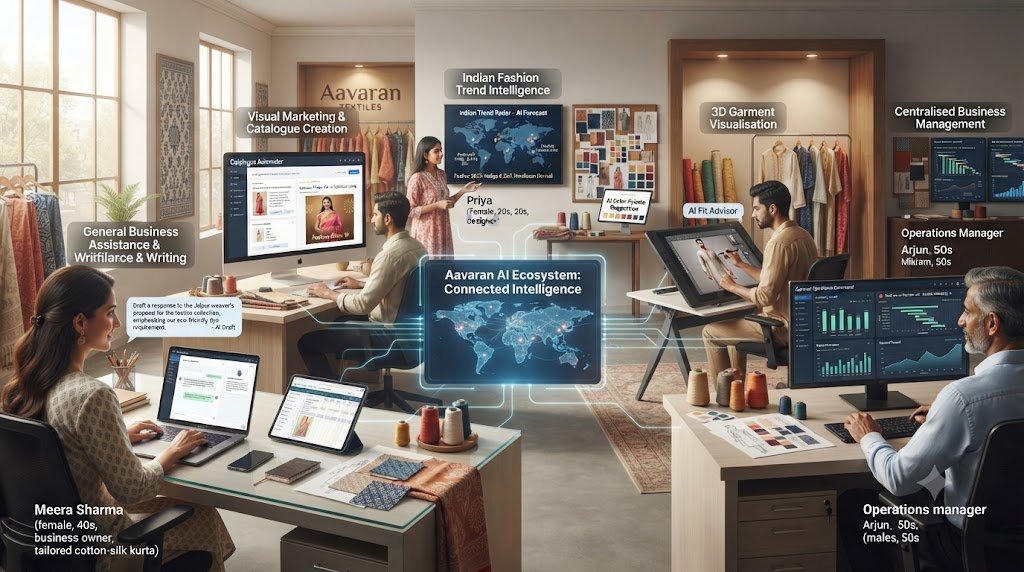
These tools solve different problems rather than competing with one another, so many businesses will eventually use more than one of these AI tools for textile businesses in India, each chosen for a specific need.
How to Slowly Implement AI in a Textile Business
Adopting several AI tools for textile businesses in India all at once rarely works well, no matter how promising each one looks individually. A gradual approach tends to produce better results.
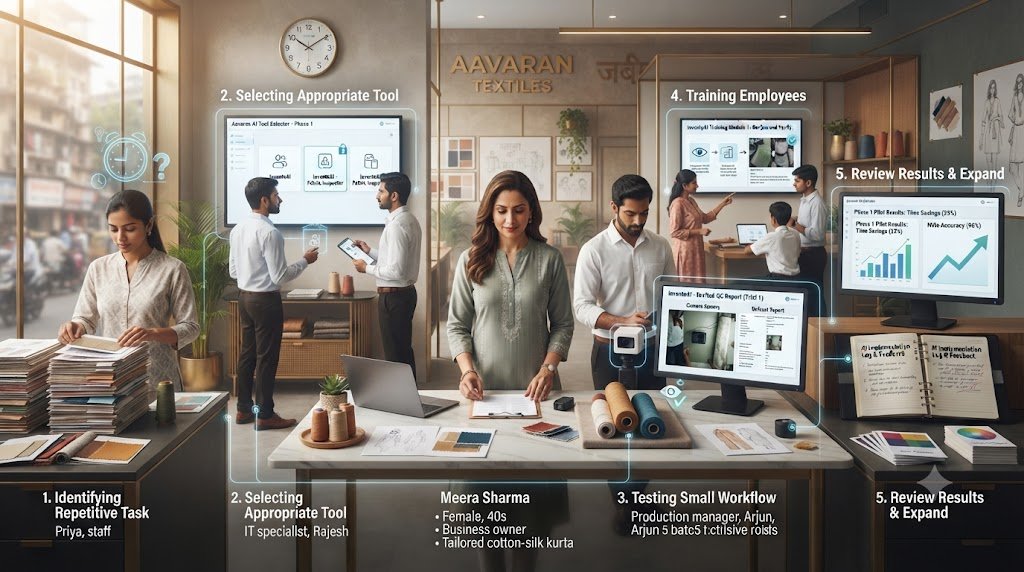
Step 1: Identify Repetitive Work — Look for tasks that consume time without needing constant judgement: repetitive customer questions, catalogue writing, or data summarising.
Step 2: Start With One Problem — Resist introducing AI across design, marketing, inventory, and service in the same month.
Step 3: Choose the Right Tool — Match the tool to the specific problem rather than picking whichever of the available AI tools for textile businesses in India is most talked about.
Step 4: Run a Small Pilot — Test the chosen tool with one department or workflow before rolling it out further.
Step 5: Train Employees — Make sure staff understand what the tool does, what it doesn’t do, and that outputs need checking, especially prices and specifications.
Step 6: Measure Results and Expand — Track time saved, error rates, and costs before deciding whether to expand.
Small and medium Indian textile businesses don’t need an expensive, enterprise-wide AI system on day one. One well-chosen tool, used consistently, usually beats a large rollout.
Disadvantages and Risks of Using AI in Textile Businesses
We have talked about the advantages of AI, but it is equally important to understand the disadvantages and risks of using AI in textile businesses.
- Incorrect or misleading outputs — confident-sounding but wrong information is risky for pricing, specifications, or compliance details.
- Poor-quality business data — forecasting and analysis are only as good as the sales, inventory, and production data feeding them.
- Implementation costs — setting up AI tools, especially ERP or manufacturing-floor systems, can involve real cost and time.
- Employee training gaps — without training, staff may misuse tools or trust outputs too readily.
- Integration problems — new AI tools may not connect smoothly with existing software or legacy systems.
- Cybersecurity and data privacy — business and customer data shared with AI tools needs careful handling.
- Over-reliance on AI — treating output as automatically correct, without review, is a common mistake.
- Legacy machinery challenges — older equipment may not easily support modern AI-based monitoring.
- Lack of skilled employees — smaller businesses may lack staff experienced in managing AI tools.
- Unclear ROI for some use cases — not every AI investment pays off quickly, particularly for niche workflows.
- Design outputs need human review — AI-generated ideas require a trained eye before becoming actual products.
- Protecting confidential information — designs, pricing, and supplier details are competitively sensitive and shouldn’t be shared carelessly with external tools.
None of this means AI should be avoided. It means AI does not eliminate the need for experienced designers, production managers, quality teams, sales professionals, and business owners — it works alongside them, not instead of them.
FAQs
What are the best AI tools for textile businesses in India? There’s no single best tool. ChatGPT, Canva AI, VisioNxt, TRI3D, and ERPNext each address different needs, from general assistance and marketing to trend forecasting, visualisation, and business management.
How can AI help textile manufacturers? AI can assist with demand forecasting, production planning, quality inspection, and business reporting — some of the most requested AI tools for textile businesses in India come from manufacturers solving exactly these problems.
Can AI help with textile design? Yes. Generative AI can help brainstorm patterns and colours, though a trained designer is still needed to refine ideas into producible designs.
Can small textile businesses use AI? Yes. Small businesses can start with the simplest AI tools for textile businesses in India — marketing content or catalogue writing — before considering larger systems.
How can AI improve textile inventory management? AI can analyse sales and demand patterns to help predict stock needs, reducing the risk of overstocking or running out of popular products.
Can AI help garment businesses with marketing? Yes. AI tools can draft captions, campaign ideas, and product descriptions, though content should be reviewed for accuracy and tone before publishing.
Is AI expensive for textile businesses? It depends on the tool. Some assistants and design tools are low-cost or free to start with, while ERP systems and manufacturing-floor AI typically involve more setup and ongoing cost, and pricing varies by plan.
What are the risks of using AI in the textile industry? Key risks include inaccurate outputs, poor data quality, privacy concerns, integration challenges, and over-reliance on AI without human review.
Bottom Line
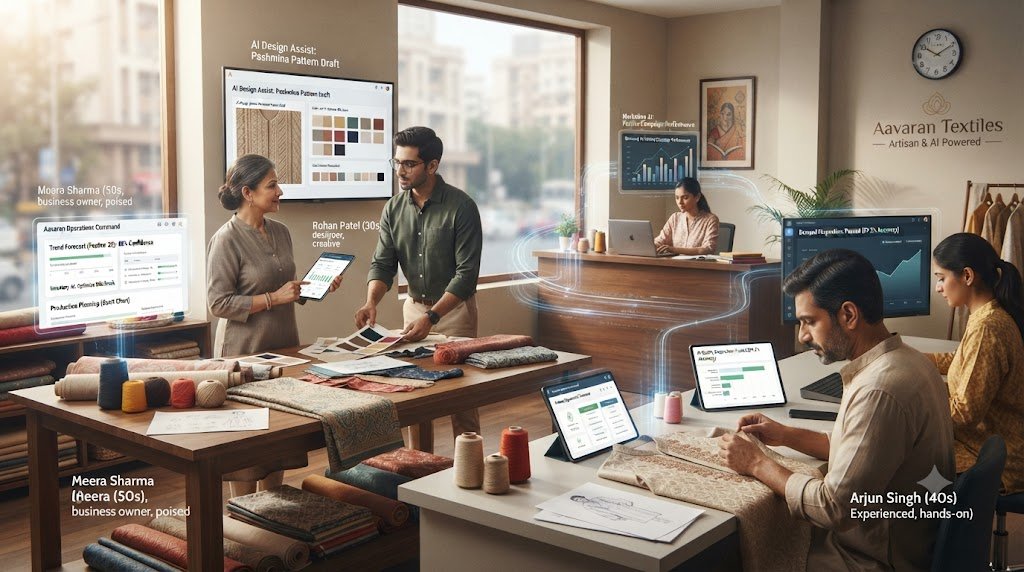
AI tools for textile businesses in India can support design, marketing, trend forecasting, inventory management, production planning, visualisation, and broader business operations. From a boutique label drafting Instagram captions to a manufacturer consolidating operations in an ERP system, the practical applications are wide-ranging.
The goal isn’t to replace textile expertise with AI. It’s to combine human expertise — in design, production, sales, and business judgement — with AI tools that handle repetitive or data-heavy tasks faster and more consistently.
For a business like Ramesh’s, the smartest starting point isn’t trying to automate everything at once. It’s picking one genuinely time-consuming problem, testing an appropriate tool against it, and expanding once it proves useful.
Published by Crackk.com
Crackk.com covers artificial intelligence, AI tools, automation, technology, and practical AI applications for businesses, helping founders and professionals understand how to use emerging technology effectively in real-world work.