
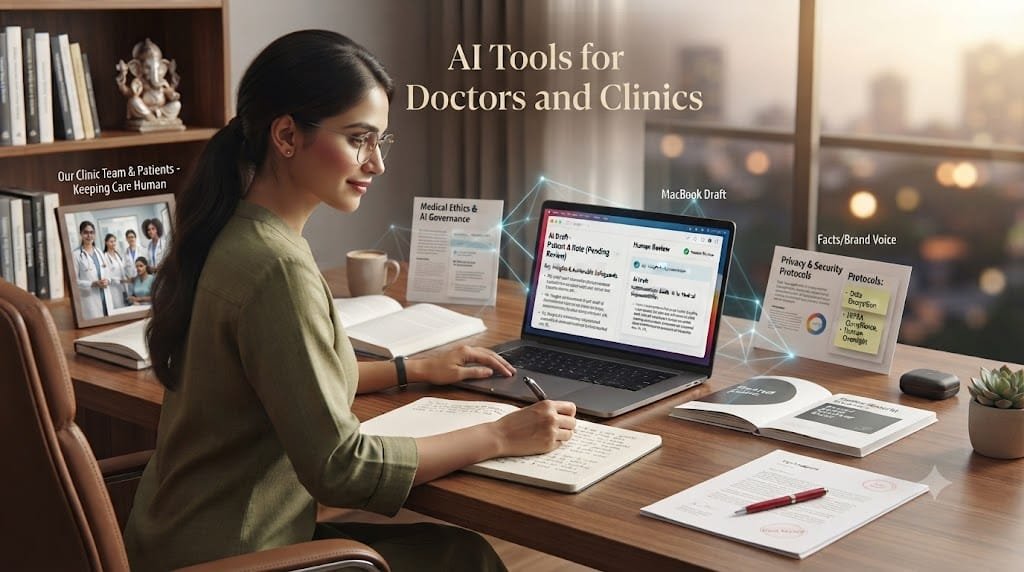
AI Tools for Doctors and Clinics
Introduction
A doctor finishes seeing the last patient of the day and finally sits down, expecting to catch a breath. Instead, patient notes still need completing, reports need reviewing, emails need answering, referrals need preparing, and administrative tasks wait on the computer.
For many doctors and clinic staff, the workday doesn’t end when the last patient leaves.
This is where artificial intelligence can become useful. This kind of daily pressure has pushed more clinics toward AI tools for doctors.
Imagine the same doctor using AI to help organise information, draft routine documentation, summarise approved material, prepare patient-friendly explanations, and handle repetitive administrative work. Instead of spending most of his time on paperwork, he can spend most of his time with patients and clinical requirements.
This is becoming a practical use of AI tools for doctors and clinics.
AI isn’t intended to replace doctors. In healthcare, professional judgement, patient relationships, examination, diagnosis, treatment decisions, and accountability remain essential. Instead, AI can act as an assistant that helps reduce repetitive work and makes certain workflows more efficient.
From documentation and research to patient communication and clinic administration, AI is creating new possibilities for healthcare professionals.
But there is another side to the conversation. Healthcare involves extremely sensitive information, and mistakes can have serious consequences. Therefore, clinics need to understand both the benefits and limitations of AI before introducing it.
In this guide, we’ll explore how AI is being used in clinics, practical applications, five AI tools for doctors and clinics to consider, how to implement AI gradually, and the disadvantages healthcare organisations should understand before adopting it.
How AI Tools for Doctors and Clinics Have Changed Healthcare
Healthcare professionals have always had to balance two responsibilities: managing patients and managing a large amount of information and administrative work.
AI can help with the second responsibility; that is what AI tools for doctors and clinics are designed to fill.
Modern healthcare AI systems can assist with tasks such as documentation, information summarisation, research, patient communication, and administrative workflows.
For example, AI-powered clinical documentation tools can listen to a clinical conversation and, when deployed correctly and with the required permissions, help create a draft clinical note. The clinician can then review and edit the documentation rather than starting from a blank page.
Other AI systems can help transform complex medical information into easier-to-understand patient education material.
Healthcare organisations are also exploring AI for administrative processes, research, workflow management, and operational support.
OpenAI, for example, describes healthcare applications of its products, including synthesising medical evidence, drafting clinical and administrative documentation, and creating patient-facing educational material, while keeping clinicians responsible for decisions.
The important change is not simply that doctors now have access to AI.
The bigger transformation is that most tasks that required considerable manual work can now be accomplished more easily.
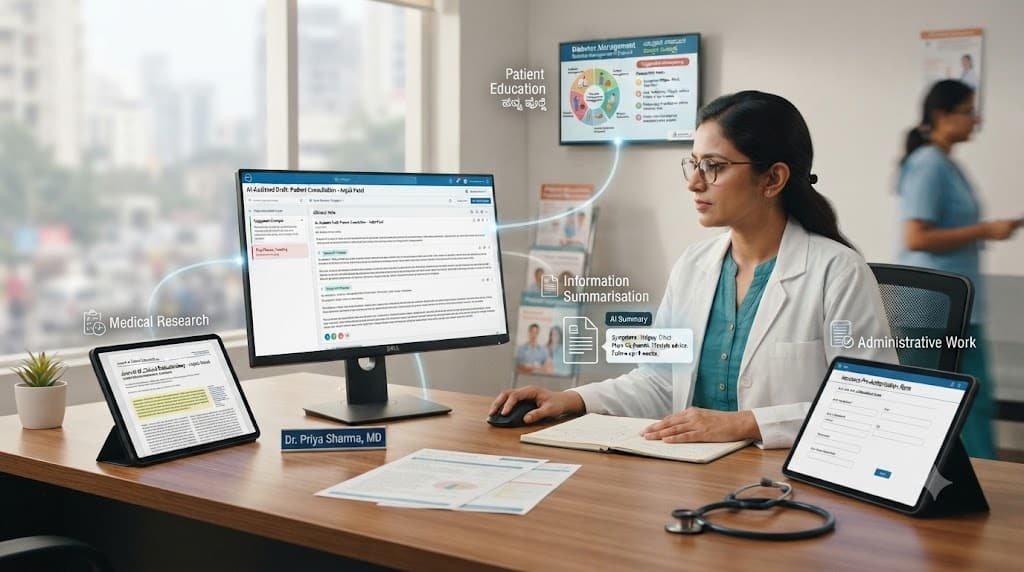
Best Uses of AI Tools for Doctors and Clinics
Many tools are available in healthcare, but clinics should focus on practical problems rather than adopting AI simply because it is popular. The list below covers the most practical uses of AI tools for doctors and clinics today.
Here are some of the most useful areas.
- Clinical Documentation
Documentation can take up a considerable amount of time for healthcare professionals. This is one of the most common entry points for AI tools for doctors and clinics.
AI-powered documentation tools can help generate draft notes from clinical conversations or information provided during a consultation.
The doctor can then review the output, correct errors, and finalise the record.
This can reduce the amount of manual typing required.
However, the final clinical documentation should remain under appropriate professional review.
- Medical Research and Information Search
Doctors and medical professionals often need to keep up with research, clinical guidelines, and medical literature.
AI can help organise and summarise information, making it easier to identify relevant material, one of the quieter strengths of AI tools for doctors and clinics.
Some healthcare-specific AI products provide access to cited clinical sources so professionals can verify the underlying evidence. ChatGPT for Healthcare, for example, offers clinical search with citations and access to approved healthcare information sources.
AI should support research rather than become an unquestioned source of truth.
- Patient Education
Medical terminology can be difficult for patients to understand.
AI can help doctors and clinic staff draft patient-friendly explanations of complex topics.
For example, a doctor could use an appropriate AI system to turn technical information into a simpler explanation that can be reviewed before being given to a patient.
The objective isn’t to remove the doctor from the conversation. It is to make information easier to understand.
- Administrative Work
Clinics deal with many non-clinical tasks.
These can include:
- Drafting routine emails
- Preparing letters
- Organising information
- Creating forms
- Summarising documents
- Preparing internal reports
- Creating staff instructions
- Drafting patient communications
AI can assist with many of these tasks and potentially reduce repetitive work, which is why administrative support is one of the most requested uses of AI tools for doctors and clinics.
- Referral and Prior-Authorisation Documentation
Some healthcare workflows require extensive documentation.
AI can help draft certain administrative documents based on information provided in an approved and appropriately governed environment.
For example, ChatGPT for Healthcare lists drafting prior-authorisation letters and referral-related documentation among supported workflows.
The healthcare professional should review the final document before it is submitted.
- Patient Communication
Clinics frequently answer repetitive questions about appointments, preparation instructions, opening hours, services, and administrative procedures.
AI-powered systems can help create or automate appropriate responses.
However, clinics should clearly distinguish between routine administrative communication and clinical questions that require a qualified professional.
- Summarising Information
Doctors and clinic staff may need to review large amounts of information, and summarisation is one of the more time-saving AI tools for doctors and clinics available today.
AI can help summarise approved documents or information, allowing professionals to identify important points more quickly.
This can be particularly useful for administrative reports, research materials, and other documentation.
Any clinically important summary should be verified against the original information.
- Staff Training
AI can help clinics create internal training material, and this remains one of the more underused AI tools for doctors and clinics.
For example, it can assist with:
- Staff onboarding documents
- Communication scripts
- Administrative checklists
- Training quizzes
- Standard operating procedure drafts
- Patient-service guidelines
This can help clinics standardise certain processes.
- Translation and Plain-Language Communication
Healthcare organisations often serve people with different language backgrounds and varying levels of health literacy.
AI can assist with translating or simplifying patient-facing material.
However, important medical communications should receive appropriate human review, particularly when errors or ambiguity could affect patient understanding.
- Clinic Marketing and Content
AI can also help with the business side of running a clinic.
Doctors and clinic owners can use AI to brainstorm:
- Blog topics
- Health-education content
- Social-media posts
- Newsletter ideas
- Website copy
- Awareness campaigns
Medical content requires greater caution than ordinary marketing content because inaccurate health claims can mislead patients.
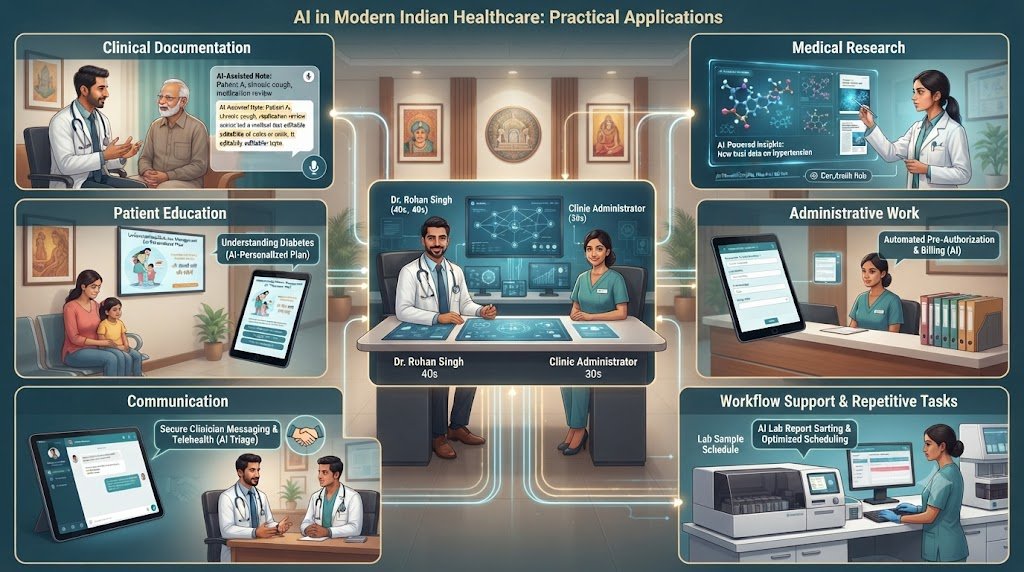
Best AI Tools for Doctors and Clinics
ChatGPT
ChatGPT is a general-purpose AI assistant that can support a wide range of professional tasks, and it remains one of the most widely adopted AI tools for doctors and clinics.
Cracckk.com has previously covered ChatGPT in its AI-tool content, making it a useful tool to revisit in a healthcare context.
For healthcare organisations, the relevant product and deployment matter. OpenAI currently offers healthcare-specific versions designed for clinical and organisational use. ChatGPT for Healthcare supports tasks including evidence synthesis, documentation, patient-ready explanations, and approved organisational workflows.
Doctors and clinic teams can potentially use appropriate ChatGPT deployments for tasks such as:
- Drafting administrative documents
- Summarising approved information
- Preparing patient education drafts
- Research assistance
- Creating internal training material
- Organising workflow ideas
- Drafting communications
However, clinics should not assume that an ordinary consumer AI account is automatically appropriate for handling protected health information.
OpenAI specifically distinguishes healthcare products and eligible configurations for regulated use, including Business Associate Agreement arrangements for applicable products.
Best for: Administrative assistance, research support, documentation drafts, patient education, general productivity.
Microsoft Copilot
Microsoft Copilot can be useful for organisations already working extensively with Microsoft’s productivity ecosystem.
Depending on the product and organisational setup, AI assistance can be incorporated into workflows involving documents, email, meetings, spreadsheets, and other business activities.
For a clinic, this can potentially help administrative teams draft communications, summarise meetings, organise information, and work more efficiently with everyday productivity tasks.
Its usefulness will depend heavily on the clinic’s existing Microsoft environment and the specific Copilot product being deployed.
Best for: Administrative productivity, emails and documents, meeting assistance, organisational workflows, Microsoft-based workplaces.
For healthcare use, clinics should evaluate the exact product, data controls, permissions, and compliance arrangements rather than assuming that every Copilot feature is suitable for patient information.
Abridge
Abridge focuses on AI-powered clinical documentation and is one of the more specialised AI tools for doctors and clinics on this list.
Its technology is designed around clinical conversations and documentation workflows, helping transform conversations between clinicians and patients into useful clinical documentation.
This can potentially reduce the amount of time clinicians spend manually documenting encounters.
Abridge has also continued expanding its healthcare intelligence platform and clinical workflow capabilities.
Best for: Clinical documentation, ambient note generation, reducing documentation workload, healthcare organisations.
The key consideration is that the documentation made by the AI should be checked by a medical professional before becoming part of the clinical record.
Nabla Copilot
Nabla Copilot is designed to assist clinicians with documentation.
Tools in this category can help create clinical notes from patient consultations, allowing clinicians to spend less time manually writing documentation.
For clinics considering an ambient documentation solution, factors such as supported specialities, EHR integrations, languages, security, privacy, and deployment requirements should be evaluated before adoption.
Best for: Clinical notes, documentation assistance, reducing administrative workload.
The tool should be treated as a documentation assistant rather than an autonomous clinical decision-maker.
DAX Copilot
DAX Copilot is Microsoft’s healthcare-focused ambient clinical documentation technology.
It is designed to help clinicians capture and transform patient conversations into clinical documentation.
For larger healthcare organisations, ambient documentation tools can be particularly relevant because documentation is a recurring workload across many consultations.
Best for: Ambient clinical documentation, clinical workflow support, large healthcare organisations, reducing documentation burden.
As with any clinical AI system, clinics should assess accuracy, workflow integration, privacy, security, regulatory requirements, and human review before deployment.

Comparison Table
| AI Tool | Best For | Main Use | Ease of Use | Key Consideration |
|---|---|---|---|---|
| ChatGPT | General AI assistance | Research, documentation, communication, education | Easy–Medium | Use the appropriate healthcare/enterprise deployment for sensitive data |
| Microsoft Copilot | Administrative productivity | Documents, emails, meetings, workflows | Easy–Medium | Evaluate the exact product and data controls |
| Abridge | Clinical documentation | Ambient documentation | Medium | Clinical review remains important |
| Nabla Copilot | Clinical notes | Documentation assistance | Medium | Check integrations and deployment requirements |
| DAX Copilot | Clinical documentation | Ambient clinical workflows | Medium | Particularly relevant to larger healthcare organisations |
There is no single tool that is suitable for every doctor or clinic, and the table above should make it easier to compare AI tools for doctors and clinics at a glance.
A small clinic focused on administrative productivity may have different needs from a large hospital system looking for ambient documentation across hundreds of clinicians.
The Downsides of Using AI Tools for Doctors and Clinics
So far, we’ve talked mostly about the upside. But AI tools for doctors and clinics come with real trade-offs and risks that healthcare organisations need to weigh carefully before adoption.
Accuracy is never guaranteed. AI-generated summaries, notes, or answers can be incorrect, and in healthcare even a small mistake can matter far more than in most other industries.
Patient privacy is a serious concern. Names, diagnoses, test results, and medications should never simply be pasted into a general-purpose AI tool without understanding exactly how that data is stored, accessed, and protected.
Over-reliance is a real risk. A confident-sounding AI answer isn’t the same as a clinically verified one, and professionals need to keep questioning outputs rather than accepting them automatically.
Implementation isn’t free. Software costs, integration work, and staff training can add up, and for a small clinic the expense may not always be justified by the time saved.
Staff need real training. Without it, a tool meant to save time can quietly create more work, confusion, or inconsistent use across a team.
Integration can be messy. If an AI system doesn’t connect properly with existing EHR, billing, or scheduling software, staff may end up re-entering the same information across multiple systems.
Patients may feel uneasy. Some people are uncomfortable knowing AI was involved in their documentation or communication, so transparency about its use matters.
Bias can creep in. AI systems reflect the data and design choices behind them, and outputs may not always account for an individual patient’s specific circumstances.
Regulation adds complexity. Requirements vary by country, jurisdiction, and organisation type, and healthcare AI decisions should involve legal, privacy, and compliance input.
It cannot replace human care. Empathy, physical examination, informed consent, and the doctor-patient relationship are things no AI tool can substitute for.
None of this means AI tools for doctors and clinics aren’t worth using — it means they belong in a workflow with clear human oversight, not as an unsupervised decision-maker.
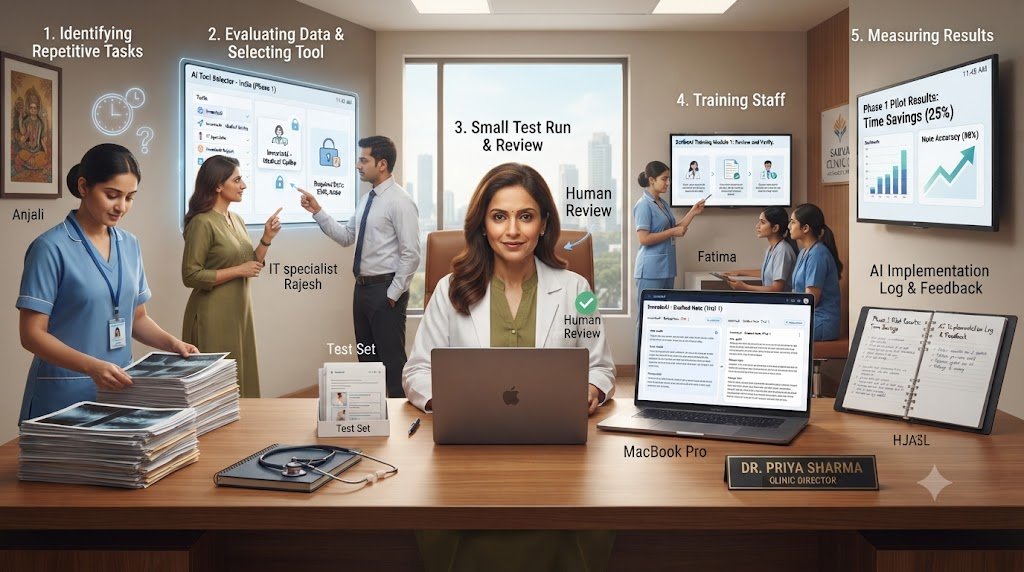
How to Slowly Implement AI Tools for Doctors and Clinics
Healthcare organisations should avoid attempting to automate everything at once, especially when rolling out several AI tools for doctors and clinics in the same quarter.
AI adoption should start with a clearly defined problem and a controlled workflow.
Step 1: Identify a Repetitive Task
Start by identifying a task that consumes time without requiring the highest level of clinical judgement.
Documentation, administrative writing, internal communication, or patient education drafts may be potential starting points.
Step 2: Determine What Data the Task Requires
Before choosing a tool, identify whether the workflow involves sensitive patient information.
This is critical.
A clinic should never assume that because a product is marketed as one of the “AI tools for doctors and clinics,” every feature is automatically appropriate for every type of patient data.
Review the provider’s security, privacy, contractual, and compliance documentation.
Step 3: Choose One Tool
Start with one tool that directly addresses the chosen problem — not every one of the available AI tools for doctors and clinics needs to be adopted at once.
For example, a clinic struggling with documentation could evaluate an ambient documentation platform rather than introducing five unrelated AI products simultaneously.
Step 4: Create a Human Review Process
Determine who checks the AI output.
For example: patient consultation, AI creates a draft note, doctor reviews and corrects it, final note entered into the clinical workflow.
The AI should not be allowed to silently become the final authority.
Step 5: Train Staff
Doctors, nurses, administrators, and other relevant staff should understand:
- What the AI does
- What information can be entered
- What information should not be entered
- How outputs should be reviewed
- When AI should not be used
- How errors should be reported
Step 6: Measure the Results
After implementation, measure whether the system actually helps.
Look at:
- Time saved
- Documentation workload
- Error rates
- Staff satisfaction
- Patient experience
- Workflow delays
- Costs
If the results are positive and risks are controlled, the clinic can expand the workflow.
Step 7: Expand Carefully
Once one workflow works reliably, the clinic can consider another.
For example: documentation, then administrative communication, then patient education, then research support, then additional workflow automation.
The goal should be controlled adoption rather than maximum automation.
FAQs
Can AI replace doctors?
No. AI can assist with documentation, research, administration, communication, and other workflows, but doctors remain responsible for clinical judgement and patient-care decisions, no matter how capable AI tools for doctors and clinics become.
How can doctors use AI?
Doctors can use appropriately deployed AI for documentation, research, patient education, administrative work, drafting communications, and other workflow-support tasks.
Is AI safe for patient information?
It depends on the specific AI product, configuration, data practices, agreements, security controls, and applicable regulations. Clinics should never assume that a general-purpose AI tool is automatically appropriate for protected health information.
Can AI write clinical notes?
Yes. Ambient clinical documentation systems can generate draft clinical notes from patient-clinician conversations. The clinician should review and finalise the documentation.
Can small clinics use AI?
Yes. Small clinics can start with relatively simple workflows such as administrative writing, patient communication, documentation support, or content creation. They should begin with a clearly defined problem rather than attempting a large-scale deployment immediately.
Does AI reduce doctors’ workload?
It can reduce workload for certain tasks, particularly repetitive documentation and administrative work. The actual benefit depends on the tool, workflow, implementation quality, and amount of human review required.
What is the biggest risk of AI in healthcare?
There isn’t one universal risk. Accuracy, privacy, inappropriate reliance, bias, security, integration, and regulatory issues can all matter depending on the use case.
Should every clinic start using AI?
Not necessarily. Clinics should first identify a genuine problem, evaluate whether AI is an appropriate solution, assess risks and costs, and then test the technology in a controlled workflow.

The Bottom Line
AI tools for doctors and clinics are changing how healthcare teams approach documentation, research, administration, patient communication, and other repetitive tasks.
But healthcare is different from many other industries.
A mistake in a social-media caption is inconvenient. A mistake in a clinical workflow can have much more serious consequences.
That is why the smartest approach isn’t to use AI everywhere.
It is to use it where it provides clear value and where appropriate safeguards can be put in place.
Start with one repetitive task. Choose a tool designed for that task. Understand its privacy and security requirements. Train the staff who will use it. Build human review into the workflow. Then measure the results before expanding.
The future of healthcare AI is not necessarily about doctors versus machines.
It is about finding practical ways for doctors and AI tools for doctors and clinics to work together while keeping patient safety, privacy, and professional judgement at the centre.
For clinics willing to adopt AI tools carefully, the opportunity is straightforward: less unnecessary administrative work, more efficient workflows, and more time for the human side of healthcare.
Published by Crackk.com
Crackk.com covers artificial intelligence, AI tools, automation, technology, and practical AI applications for businesses, helping founders and professionals understand how to use emerging technology effectively in real-world work.