
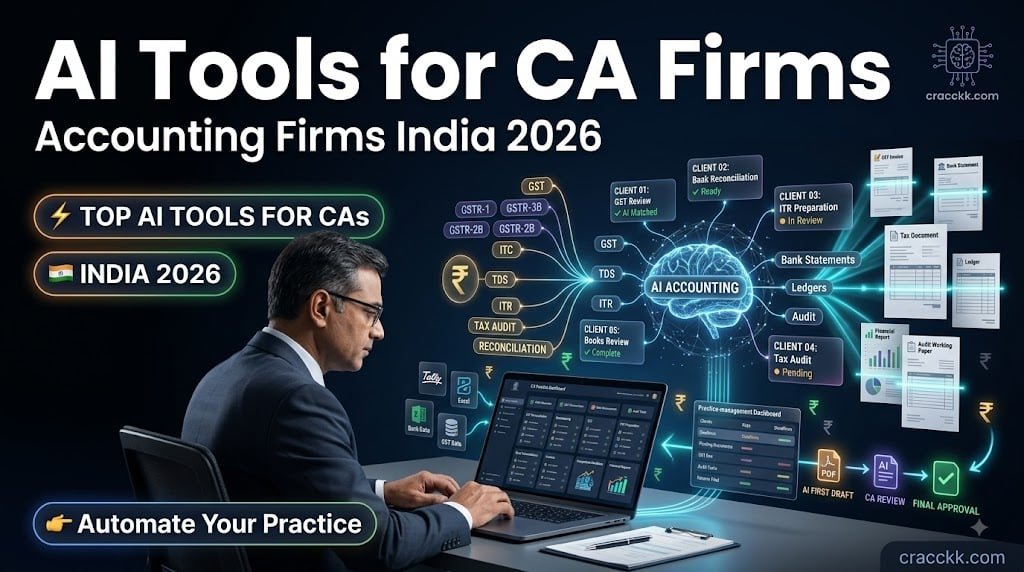
AI Tools for CA and Accounting Firms India 2026
Introduction
When Priya opened her Chartered Accountancy firm in Bengaluru, she expected long hours during tax season.
She didn’t expect the endless repetition.
Every day looked almost identical.
Download client statements.
Match invoices.
Check GST records.
Prepare financial reports.
Review tax documents.
Answer the same client questions.
Repeat.
As her client base grew, so did the paperwork.
Instead of spending time helping businesses make better financial decisions, her team spent most of the day performing manual tasks that software should have been doing.
Hiring more employees wasn’t the answer.
The workload kept increasing faster than the team could grow.
Then one of her colleagues introduced her to AI-powered accounting tools.
Initially, Priya was sceptical.
She believed AI would never understand accounting regulations well enough to be useful.
After testing a few platforms, her opinion changed completely.
AI began categorising expenses automatically.
Invoices were extracted without manual entry.
Bank transactions reconciled themselves.
Potential GST mismatches were highlighted before filing.
Financial reports that once took hours appeared in minutes.
Instead of replacing accountants, AI removed the repetitive work that prevented them from delivering higher-value advisory services.
Today, her firm serves more clients than ever while spending significantly less time on manual bookkeeping.
Her accountants now focus on consulting, tax planning, audits, compliance strategy, and helping businesses grow rather than spending entire days entering numbers into spreadsheets.
Stories like Priya’s are becoming common across India.
Artificial Intelligence is transforming the accounting profession.
Rather than replacing Chartered Accountants, AI is becoming their most valuable assistant.
Modern AI accounting platforms can automatically process invoices, reconcile bank statements, identify accounting anomalies, prepare GST reports, generate financial statements, forecast cash flow, and even answer common accounting questions using natural language.
For accounting firms, this means greater efficiency, fewer errors, faster turnaround times, and the ability to serve more clients without dramatically increasing staff.
In this guide, we’ll explore the best AI tools for Chartered Accountants and accounting firms in India in 2026, compare their features, pricing, strengths, and ideal use cases, helping you choose the right software for your practice.
Why AI Is Transforming Accounting Firms in India
Accounting has always been about accuracy, compliance, and trust. But as businesses are generating more financial data than ever, managing it all manually has become a major challenge. Chartered Accountants now handle GST filings, income tax returns, audits, payroll, bookkeeping, financial reporting, compliance, and advisory services—often for dozens or even hundreds of clients at the same time.
That’s where AI is making a significant impact.
Modern accounting software doesn’t just record transactions anymore. Its AI can now automatically categorise, detect duplicate entries, identify unusual transactions, forecast cash flow, and prepare reports within minutes. Expenses, extract data from invoices, reconcile bank statements,
Now, instead of spending hours on repetitive bookkeeping, accountants can focus on analysing financial data, advising clients, improving tax strategies, and helping businesses make better financial decisions.
AI also reduces human error.
Manual data entry is one of the biggest causes of accounting mistakes. AI-powered platforms minimise these errors by validating financial records automatically and highlighting inconsistencies before they become costly problems.
For accounting firms, this means faster turnaround times, greater efficiency, improved client satisfaction, and the ability to manage more clients without a proportional increase in staff.
Who Should Use AI Accounting Tools?
AI isn’t only for large accounting firms.
Professionals and businesses of every size can benefit from automation.
These tools are ideal for:
- Chartered Accountants
- Accounting firms
- Tax consultants
- Bookkeepers
- Financial advisors
- Small businesses
- Startups
- Freelancers
- MSMEs
- CFO service providers
Whether you’re managing five clients or five hundred, AI helps reduce repetitive work while improving accuracy and productivity.
Who Should Use AI Accounting Tools?
AI isn’t only for large accounting firms.
Professionals and businesses of every size can benefit from automation.
These tools are ideal for:
- Chartered Accountants
- Accounting firms
- Tax consultants
- Bookkeepers
- Financial advisors
- Small businesses
- Startups
- Freelancers
- MSMEs
- CFO service providers
Whether you’re managing five clients or five hundred, AI helps reduce repetitive work while improving accuracy and productivity.
1 — Zoho Books
Best For: Chartered Accountants, SMEs, and accounting firms looking for complete AI-powered accounting and GST management.
Free Plan: Yes (for eligible businesses)
Paid From: Affordable monthly plans
Difficulty: ⭐ Easy
For many accounting professionals, Zoho Books has become one of the most complete accounting platforms available in India.
Instead of using separate applications for bookkeeping, invoicing, GST, banking, inventory, and financial reporting, Zoho Books combines everything into one intelligent platform.
Its biggest advantage is automation.
Every invoice, payment, expense, and purchase is automatically recorded and organised, reducing manual bookkeeping while improving financial accuracy.
The software also generates GST-compliant invoices, tracks Input Tax Credit (ITC), prepares GST reports, and simplifies tax compliance for businesses operating across India.
One of Zoho Books’ standout features is Zia, Zoho’s AI assistant.
Zia helps accountants by analysing financial data, identifying unusual transactions, forecasting cash flow, answering accounting questions, and providing useful business insights based on real-time financial information.
Bank reconciliation is another area where AI saves significant time. The software automatically imports bank transactions, matches them against accounting records, and flags discrepancies for review, eliminating the need for manual reconciliation.
For firms managing multiple clients, Zoho Books also integrates with other Zoho applications, making client management, collaboration, document storage, and reporting much more efficient.
How Accounting Firms Use Zoho Books
Many Chartered Accountants use Zoho Books to:
- Automate bookkeeping.
- Generate GST-compliant invoices.
- Track expenses and revenue.
- Reconcile bank transactions.
- Prepare GST reports.
- Monitor client cash flow.
- Generate financial statements.
- Manage multiple client accounts.
Instead of spending hours on routine bookkeeping, accountants can focus on tax planning, compliance, and financial consulting.
Key AI Features
- AI-powered assistant (Zia)
- Automated bookkeeping
- Smart bank reconciliation
- GST-ready accounting
- Cash flow forecasting
- Financial analytics
- Expense categorisation
- Business performance reporting
For accounting firms that want a complete AI-powered financial management solution, Zoho Books remains one of the strongest choices available in India in 2026. It combines intelligent automation, GST compliance, accounting, and financial insights into one platform that scales with growing firms.
2 — TallyPrime
Best For: Chartered Accountants and accounting firms managing multiple clients with advanced accounting, GST compliance, and financial reporting.
Free Plan: Free trial available
Paid From: One-time license with optional annual support
Difficulty: ⭐⭐ Medium
For decades, Tally has been one of the most trusted accounting solutions in India, and in 2026, TallyPrime continues to be a favourite among Chartered Accountants and accounting firms.
While many businesses know Tally for bookkeeping, today’s TallyPrime offers much more. It combines accounting, GST compliance, inventory management, payroll, banking, and intelligent automation into a single platform that helps accounting professionals work more efficiently.
One of TallyPrime’s biggest strengths is its ability to automate routine accounting tasks.
Every transaction entered into the software automatically updates ledgers, tax calculations, inventory records, and financial statements. This eliminates duplicate data entry while ensuring financial records remain consistent throughout the business.
For CA firms managing dozens of clients at a time, this automation tool significantly reduces time spent on bookkeeping.
GST compliance is another area where TallyPrime excels.
The software automatically prepares GST reports, generates GST-compliant invoices, supports e-invoicing and e-way bills, and helps the accountants identify any discrepancies before returns are filed.
Its Edit Log feature is especially valuable for professional firms. Every modification made within the accounting system is recorded, creating a complete audit trail that improves transparency and helps businesses meet regulatory requirements.
TallyPrime also provides real-time financial dashboards, allowing accountants to monitor cash flow, outstanding receivables, profitability, and business performance without manually preparing reports.
Instead of spending hours compiling financial statements, accountants can instantly access the information they need to advise clients.
How Accounting Firms Use TallyPrime
Many CA firms use TallyPrime to:
- Manage bookkeeping for multiple clients.
- Prepare GST returns.
- Generate financial statements.
- Handle payroll processing.
- Manage inventory accounting.
- Reconcile bank transactions.
- Produce audit-ready financial records.
- Monitor business performance.
Its flexibility makes it suitable for businesses ranging from small retailers to large manufacturing companies.
Key AI Features
- Automated bookkeeping
- GST-ready accounting
- Smart financial reporting
- Intelligent business dashboards
- Edit Log for audit compliance
- E-invoicing and e-way bill support
- Inventory and payroll integration
- Banking reconciliation
For Chartered Accountants already working within the Tally ecosystem, TallyPrime remains one of the most reliable accounting platforms available in India in 2026. Its automation features, regulatory compliance tools, and comprehensive accounting capabilities make it an excellent solution for firms managing clients across multiple industries.
3 — Clear GST (ClearTax)
Best For: Chartered Accountants, tax consultants, and accounting firms handling GST compliance for multiple clients.
Free Plan: Limited free features
Paid From: Custom pricing
Difficulty: ⭐ Easy
For CA firms that spend a large portion of their time on GST compliance, Clear GST (formerly ClearTax GST) is one of the most powerful AI-driven platforms available in India.
Unlike traditional accounting software, Clear GST focuses specifically on making GST filing, reconciliation, and compliance faster and more accurate. Its AI-powered automation dramatically reduces manual work, allowing accountants to handle more clients without increasing their workload.
One of the platform’s biggest strengths is its intelligent reconciliation engine.
Instead of manually comparing purchase invoices with supplier filings, Clear GST automatically matches invoices with GST portal data, identifies mismatches, highlights missing Input Tax Credit (ITC), and flags potential compliance issues before returns are submitted.
This helps accounting firms reduce client notices while improving filing accuracy.
Another major advantage is automated return preparation.
The software imports accounting data from popular ERP and accounting platforms, validates information, detects common filing errors, and prepares GST returns with minimal manual intervention.
For firms managing multiple businesses, Clear GST provides a central dashboard where accountants can monitor filing status, compliance deadlines, pending actions, and client accounts from one place.
This eliminates the need to switch between multiple systems throughout the day.
Clear GST also keeps users informed about changes in GST regulations, helping accounting firms stay compliant without constantly monitoring government notifications.
How Accounting Firms Use Clear GST
Many Chartered Accountants use Clear GST to:
- Prepare GST returns.
- Reconcile purchase and sales invoices.
- Track Input Tax Credit (ITC).
- Identify invoice mismatches.
- Validate GST data before filing.
- Monitor compliance deadlines.
- Manage multiple client accounts.
- Generate GST reports.
Its automation allows firms to complete GST work faster while reducing the risk of costly filing errors.
Key AI Features
- AI-powered invoice reconciliation
- Automatic GST return preparation
- Smart error detection
- ITC mismatch identification
- Compliance tracking
- Multi-client dashboard
- GST analytics and reporting
- Integration with major accounting software
For CA firms focused on GST compliance, Clear GST is one of the best AI tools available in India in 2026. Its intelligent automation, reconciliation capabilities, and client management features help accountants improve efficiency while delivering faster and more accurate GST services.
4 — QuickBooks Online
Best For: Accounting firms managing SMEs, startups, freelancers, and businesses that need cloud-based accounting with AI automation.
Free Plan: Free trial available
Paid From: Monthly subscription
Difficulty: ⭐ Easy
For accounting firms that prefer cloud-based accounting, QuickBooks Online remains one of the most capable AI-powered financial management platforms available in 2026.
Rather than simply recording transactions, QuickBooks uses artificial intelligence to automate bookkeeping, categorise expenses, reconcile bank accounts, generate financial reports, and provide real-time business insights.
For Chartered Accountants, this means spending far less time on repetitive administrative work and more time delivering strategic financial advice to clients.
One of QuickBooks’ biggest advantages is automated transaction categorisation. As bank transactions flow into the system, AI analyses spending patterns and places expenses into the appropriate accounting categories. Over time, the software learns from previous decisions, making future bookkeeping even faster.
Bank reconciliation is equally efficient. Instead of manually matching hundreds of transactions every month, QuickBooks automatically compares bank statements with accounting records and highlights only the exceptions that require human review.
The platform also includes intelligent reporting dashboards that provide instant visibility into profit and loss, cash flow, outstanding invoices, expenses, and business performance. This allows accountants to deliver faster financial reports and more meaningful insights during client meetings.
For firms managing multiple clients, QuickBooks’ cloud-based design allows accountants and business owners to collaborate in real time from anywhere, eliminating the need to exchange spreadsheets or backup files.
How Accounting Firms Use QuickBooks Online
Many accounting firms use QuickBooks Online to:
- Automate bookkeeping.
- Categorise expenses.
- Reconcile bank transactions.
- Generate financial statements.
- Track business cash flow.
- Manage invoices and payments.
- Produce tax-ready reports.
- Collaborate with clients remotely.
Its cloud-first approach makes it especially attractive for firms serving startups, digital businesses, consultants, and remote clients.
Key AI Features
- AI-powered expense categorisation
- Automated bookkeeping
- Smart bank reconciliation
- Real-time financial dashboards
- Cash flow forecasting
- Invoice and payment automation
- Tax-ready financial reports
- Cloud collaboration
For accounting firms looking for a modern cloud accounting solution, QuickBooks Online is one of the best AI-powered platforms available in 2026. Its intelligent automation, real-time collaboration, and comprehensive financial reporting help firms increase efficiency while delivering better service to their clients.
5 — Xero
Best For: Chartered Accountants, accounting firms, startups, and businesses looking for cloud-based accounting with AI-powered automation.
Free Plan: Free trial available
Paid From: Monthly subscription
Difficulty: ⭐ Easy
As accounting firms continue moving toward cloud-based workflows, Xero has become one of the most popular accounting platforms for businesses that value automation, collaboration, and real-time financial reporting.
Unlike traditional desktop accounting software, Xero allows accountants and clients to work together from anywhere. Financial data updates in real time, making it easier to monitor business performance, prepare reports, and provide timely financial advice.
One of Xero’s biggest strengths is its AI-driven bank reconciliation.
Instead of manually matching every transaction, the software automatically imports bank feeds, suggests matches, learns from previous reconciliations, and highlights only the exceptions that require attention. This dramatically reduces bookkeeping time while improving accuracy.
Xero also automates everyday accounting tasks such as invoice generation, recurring billing, payment reminders, expense tracking, and financial reporting. As businesses grow, these automations help accounting firms manage more clients without significantly increasing administrative work.
Another advantage is Xero’s powerful reporting capabilities. The platform generates profit and loss statements, balance sheets, cash flow reports, and customised financial dashboards that accountants can share directly with clients.
For firms offering advisory services, these real-time insights make client meetings more productive because financial information is always up to date.
Xero also integrates with hundreds of third-party business applications, including payroll systems, CRM software, payment gateways, inventory platforms, and e-commerce tools. This creates a connected financial ecosystem that reduces duplicate data entry and improves operational efficiency.
How Accounting Firms Use Xero
Many accounting firms use Xero to:
- Automate bookkeeping.
- Reconcile bank transactions.
- Generate financial reports.
- Manage invoices and payments.
- Track business expenses.
- Monitor cash flow.
- Collaborate with clients in real time.
- Connect accounting with third-party business apps.
Its cloud-first approach makes it especially useful for firms managing startups, digital businesses, consultants, and clients operating across multiple locations.
Key AI Features
- AI-powered bank reconciliation
- Automated bookkeeping
- Smart invoice management
- Cash flow monitoring
- Financial reporting dashboards
- Expense tracking automation
- Cloud collaboration
- Extensive third-party integrations
For accounting firms embracing digital transformation, Xero is one of the best AI-powered accounting platforms available in 2026. Its intelligent automation, real-time collaboration, and scalable cloud infrastructure help Chartered Accountants deliver faster, more accurate, and more valuable financial services to their clients.
Quick Comparison — Which AI Tool Should Chartered Accountants Choose?
Every accounting firm has different requirements. Some focus on GST compliance, while others provide bookkeeping, audits, payroll, tax planning, or CFO services. The right AI tool depends on the type of clients you serve and the services your firm offers.
| Business Need | Best Tool | Why It Stands Out |
|---|---|---|
| Complete Accounting Solution | Zoho Books | AI-powered bookkeeping, GST, invoicing, financial reporting, and cash flow insights. |
| Traditional Accounting Firms | TallyPrime | Industry-leading accounting software with GST, payroll, inventory, and audit-ready compliance. |
| GST & Tax Compliance | Clear GST | AI-powered GST reconciliation, ITC matching, and automated return preparation. |
| Cloud-Based Accounting | QuickBooks Online | Smart bookkeeping, AI expense categorisation, and real-time collaboration. |
| Growing Digital Accounting Firms | Xero | Cloud accounting with AI bank reconciliation, reporting, and third-party integrations. |
Each platform has its own strengths.
If you’re looking for an all-in-one accounting solution with intelligent automation, Zoho Books is one of the best options for modern CA firms. Firms already working within the Tally ecosystem will benefit from TallyPrime, while professionals specialising in GST compliance should strongly consider Clear GST for its advanced reconciliation and filing features.
For firms embracing remote work and cloud-based collaboration, QuickBooks Online and Xero offer excellent automation, real-time financial reporting, and seamless client collaboration.
Many successful accounting firms don’t rely on just one platform. For example, they may use TallyPrime for accounting, Clear GST for compliance, Zoho Books for smaller clients, and Xero or QuickBooks Online for startups and international businesses.
By choosing the right combination of AI tools, Chartered Accountants can reduce manual work, improve accuracy, serve more clients, and spend more time providing high-value advisory services instead of routine bookkeeping.
How to Choose the Right AI Tool for Your Accounting Firm
Choosing the right AI software isn’t about selecting the platform with the longest feature list—it’s about finding one that fits your firm’s workflow, client base, and future growth plans.
Here’s what every Chartered Accountant and accounting firm should consider before investing in AI.
- Identify Your Firm’s Biggest Time Wasters
Every accounting practice has different challenges.
Some firms spend most of their time on:
- Bookkeeping
- GST filing
- Bank reconciliation
- Payroll
- Audit preparation
- Income tax returns
- Financial reporting
Choose software that automates the tasks consuming the most time in your firm.
For example, if GST compliance dominates your workload, Clear GST may provide the biggest productivity boost. If you’re managing complete accounting services, Zoho Books or TallyPrime may be a better fit.
- Consider Your Client Base
The software should suit the businesses you serve.
For example:
- Startups often prefer cloud platforms like Zoho Books, QuickBooks Online, or Xero.
- Manufacturers and wholesalers frequently use TallyPrime.
- Retail businesses may require inventory-heavy accounting software.
- Large enterprises often need advanced GST reconciliation and compliance tools.
Selecting software that matches your clients’ systems makes collaboration much easier.
- Prioritise Automation
The biggest benefit of AI isn’t replacing accountants—it’s removing repetitive work.
Look for platforms that automatically:
- Import bank transactions
- Categorise expenses
- Process invoices
- Reconcile accounts
- Prepare GST reports
- Generate financial statements
- Detect unusual transactions
- Forecast cash flow
The more automation available, the more time your team can dedicate to advisory services and client relationships.
- Check Integration Capabilities
Your accounting software shouldn’t operate in isolation.
Modern AI platforms should integrate with:
- Banking systems
- GST portals
- Payroll software
- CRM platforms
- ERP systems
- Payment gateways
- Inventory software
- E-commerce platforms
Good integrations reduce duplicate work while improving accuracy across your entire workflow.
- Think About Future Growth
Your firm may manage 20 clients today.
In a few years, it could be 200.
Choose software that scales with your business by supporting additional users, cloud collaboration, automation, advanced reporting, and larger transaction volumes without requiring a complete migration.
Best Practices for Using AI in Accounting
AI delivers the best results when it’s used to support professional expertise—not replace it.
Always review AI-generated reports before submitting tax returns or financial statements. While automation is highly accurate, professional judgement remains essential for compliance and strategic decision-making.
Keep your accounting software updated so it reflects the latest GST rules, tax regulations, and compliance requirements.
Train your team regularly. Even the most advanced AI platform won’t improve productivity if employees don’t understand how to use its automation features effectively.
Maintain strong data security practices by enabling multi-factor authentication, controlling user access, and using encrypted cloud storage where possible. Protecting client financial information should always remain a top priority.
Finally, use the time AI saves to provide higher-value services. Clients increasingly expect financial advice, tax planning, business forecasting, and strategic guidance—not just bookkeeping. Firms that embrace this shift will build stronger client relationships and create new revenue opportunities while AI handles routine administrative work.
Frequently Asked Questions
Q: Will AI replace Chartered Accountants?
No. AI is designed to automate repetitive tasks like bookkeeping, invoice processing, bank reconciliation, and report generation. Chartered Accountants still play a critical role in tax planning, audits, financial strategy, regulatory compliance, and business advisory. AI makes accountants more productive—it doesn’t replace their expertise.
Q: Which AI accounting tool is best for CA firms in India?
The right tool depends on your firm’s needs. Zoho Books is an excellent all-round solution for accounting and GST, TallyPrime is ideal for firms already using the Tally ecosystem, Clear GST excels in GST compliance, while QuickBooks Online and Xero are excellent cloud-based solutions for firms managing startups and remote clients.
Q: Can AI automate bookkeeping?
Yes. Modern AI accounting software can automatically categorise expenses, import bank transactions, reconcile accounts, generate invoices, prepare financial reports, and organise accounting records. This significantly reduces manual data entry while improving accuracy.
Q: Is AI useful for audit preparation?
Absolutely. AI helps accountants organise financial records, identify unusual transactions, detect inconsistencies, maintain audit trails, and generate supporting reports much faster than traditional manual processes. However, the final audit opinion and professional judgement always remain the responsibility of the auditor.
Q: Can AI help manage multiple accounting clients?
Yes. Many AI accounting platforms include multi-client dashboards, automated workflows, document management, and cloud collaboration features. This allows accounting firms to manage hundreds of clients more efficiently while reducing administrative workload.
Q: Is AI accounting software suitable for small CA firms?
Definitely. Small firms often benefit the most because AI reduces repetitive work without requiring additional staff. By automating bookkeeping, GST compliance, and reporting, smaller firms can serve more clients while maintaining high service quality.
The Bottom Line
Artificial Intelligence is transforming the accounting profession—but not in the way many people expected.
Instead of replacing Chartered Accountants, AI is eliminating repetitive administrative work so professionals can focus on what truly matters: helping businesses make smarter financial decisions.
From automated bookkeeping and bank reconciliation to GST compliance, financial reporting, and cash flow forecasting, today’s AI-powered accounting tools allow firms to work faster, improve accuracy, reduce operational costs, and scale without significantly increasing headcount.
For firms seeking a complete accounting solution, Zoho Books is one of the strongest all-round platforms available. TallyPrime remains the preferred choice for traditional accounting practices, Clear GST leads in GST compliance and reconciliation, while QuickBooks Online and Xero are excellent options for firms embracing cloud accounting and digital collaboration.
The future of accounting isn’t about competing with AI.
It’s about using AI to become a better accountant.
Your Action Plan
- ✅ Identify repetitive accounting tasks that consume the most time.
- ✅ Choose AI software that matches your firm’s services and client base.
- ✅ Automate bookkeeping, GST compliance, and bank reconciliation.
- ✅ Train your team to use AI efficiently while maintaining professional oversight.
- ✅ Use the time saved to expand advisory, consulting, and tax planning services.
Accounting firms that adopt AI today won’t just improve efficiency—they’ll deliver greater value to clients, build stronger relationships, and position themselves for long-term growth in an increasingly digital financial landscape.
Which AI accounting tool are you planning to implement in your firm? Share your thoughts in the comments below.
Published by Crackkk
Helping Indian businesses, Chartered Accountants, and finance professionals grow with practical AI guides, software reviews, and actionable technology insights.
Explore more AI tools, business resources, and digital transformation guides at Crackkk.com.