
AI Tools for Retail Shop Owners
Introduction
Running a retail shop can look simple from the outside. A customer walks in, chooses a product, pays, and leaves. But behind that simple transaction, shop owners manage dozens of responsibilities every day.
They need to understand what customers want, keep the right products in stock, communicate with suppliers, create promotions, answer customer questions, manage employees, track sales, and attract new customers.
Imagine a clothing-store owner in India preparing for the festive season. The shop is getting busier, customers are asking about new arrivals on WhatsApp, several products are running low, and the owner still needs to create Instagram posts for the weekend sale.
Instead of doing everything manually, the owner starts using AI.
AI helps write product descriptions and promotional messages, analyzes sales data to identify popular products, creates social-media designs, and helps answer repetitive customer questions. The owner still makes the important decisions, but AI handles some of the repetitive work.
This is where AI tools for retail shop owners can become useful.
AI does not have to mean expensive robots or complicated technology. For many retailers, it can simply mean using an AI assistant, marketing platform, inventory system, or automation tool to make everyday work faster and more organized.
In this article, we will look at 10 practical ways retail businesses can use AI, the best AI tools for retail shop owners, how to implement AI gradually, and the disadvantages retailers should understand before adopting it.
How AI Is Changing Retail Businesses
Retail is becoming increasingly data-driven. Shop owners have access to information about sales, products, customers, inventory, marketing campaigns, and seasonal demand.
The challenge is turning this information into useful decisions.
AI can help retailers analyze information, automate repetitive tasks, create marketing material, communicate with customers, and identify patterns that may otherwise take significant time to find manually.
For example, an AI system can help a retailer analyze historical sales data and identify which products sell faster during particular periods. A marketing-focused AI tool can turn basic product information into social-media content. A chatbot can handle frequently asked questions while employees focus on customers inside the store.
For Indian retailers, AI can also be useful in businesses that rely heavily on digital communication. Many small businesses use channels such as WhatsApp and Instagram alongside their physical stores, creating more opportunities for automation and AI-assisted communication.
However, AI is not a replacement for understanding customers. A retailer’s knowledge of local demand, pricing, suppliers, and customer relationships remains extremely important.
The most practical approach is to use AI as a business assistant rather than handing every decision over to it.
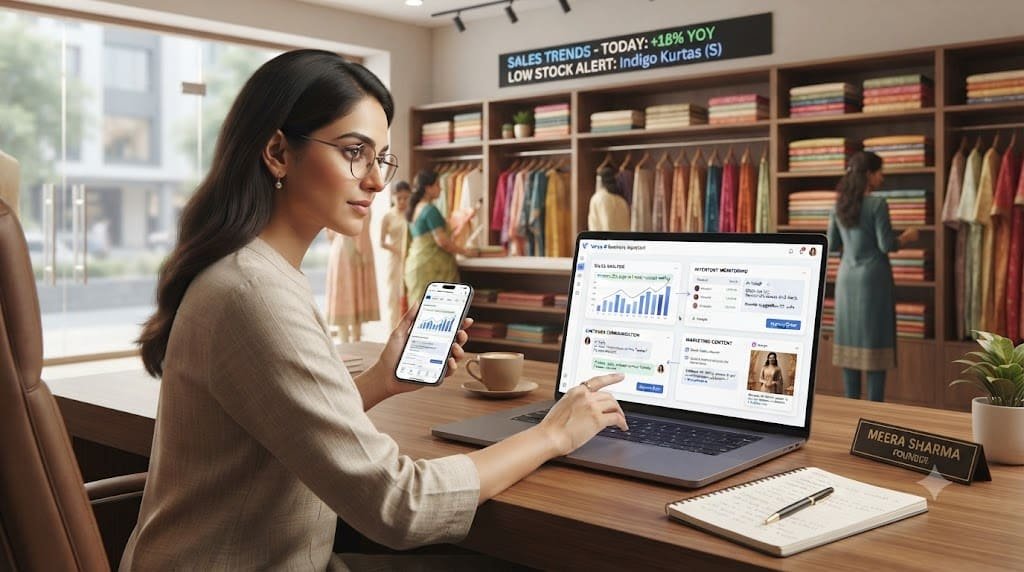
10 Ways Retail Shop Owners Can Use AI
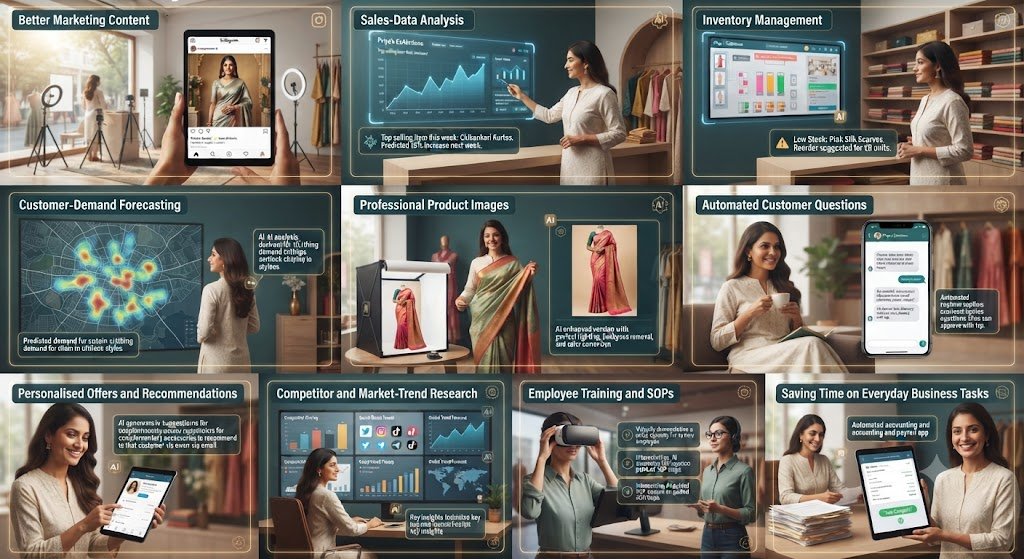
- Create Better Marketing Content
Marketing is one of the easiest areas for a retail shop to start using AI.
Instead of spending hours thinking about what to post, retailers can use AI to generate:
- Instagram captions
- Promotional messages
- WhatsApp messages
- Product descriptions
- Festival campaign ideas
- Advertisement copy
- Email content
- Content calendars
- Promotional slogans
For example, a clothing-store owner can provide AI with the details of a new collection and ask it to create five Instagram captions, three WhatsApp promotional messages, and ideas for a weekend campaign.
The owner can then review and edit the content before publishing it.
This can be particularly useful during busy periods such as Diwali, Eid, wedding seasons, school reopening periods, or end-of-season sales.
AI does not replace the retailer’s understanding of customers. Instead, it reduces the time required to turn that knowledge into marketing content.
- Analyze Sales Data
Retailers generate valuable data every day, but many small businesses do not have the time to analyze it properly.
AI can help analyze spreadsheets or structured sales information to identify patterns such as:
- Best-selling products
- Slow-moving products
- High-performing categories
- Sales trends
- Changes in demand
- Seasonal patterns
- Average order values
For example, a footwear retailer could analyze several months of sales data and discover that certain sizes sell much faster than others.
The retailer can then use that information when planning future purchases.
AI-generated analysis should still be checked against actual business records. An incorrect spreadsheet, incomplete data, or poorly structured information can lead to misleading conclusions.
- Improve Inventory Management
Keeping too much stock can tie up money, while keeping too little can lead to missed sales.
AI and intelligent inventory systems can help retailers understand inventory movement and identify products that may require attention.
Depending on the system and available data, retailers can use technology to monitor:
- Fast-moving products
- Slow-moving products
- Low-stock items
- Overstocked products
- Product turnover
- Historical demand
Consider a small electronics shop. If a particular accessory consistently sells faster than expected, an inventory system can help the owner identify the trend earlier and plan replenishment.
AI is most useful when it works with accurate and up-to-date inventory data.
- Forecast Customer Demand
One of the biggest challenges in retail is knowing what customers will want in the future.
Demand forecasting uses historical information and other relevant signals to estimate future demand.
For example, a retailer might examine previous sales around a particular festival and compare them with current sales patterns.
This can help with purchasing and stock planning.
Demand forecasting is not a crystal ball. Unexpected events, changes in fashion, local competition, price changes, or economic conditions can affect demand.
Therefore, retailers should treat AI forecasts as decision-support information rather than guaranteed predictions.
- Create Professional Product Images
Good product photography can make a major difference to online retail marketing.
AI-powered design and image tools can help retailers create:
- Promotional product images
- Social-media creatives
- Background variations
- Product banners
- Catalogue visuals
- Sale graphics
- Lifestyle-style marketing concepts
A small fashion retailer, for example, can use an AI-assisted design tool to create consistent promotional graphics for a new collection.
However, retailers should be careful when AI-generated visuals significantly change the appearance of an actual product.
Customers should receive an accurate representation of what they are purchasing.
- Automate Customer Questions
Retailers often answer the same questions repeatedly.
Customers may ask:
- What are your opening hours?
- Is this product available?
- What sizes do you have?
- Do you deliver?
- What is the price?
- Where is your shop?
- Can I exchange this product?
AI-powered chatbots and automation can help answer routine questions.
For businesses receiving many messages through digital channels, this can reduce repetitive work.
More complicated questions can still be transferred to a human employee.
The goal should not be to make customers fight with a chatbot. The goal is to use automation for simple questions while keeping human support available when customers need it.
- Personalize Offers and Recommendations
Retailers often know their regular customers well. AI can potentially make this understanding more systematic by analyzing purchase patterns where appropriate data is available.
For example, a retailer could identify customers who frequently purchase a particular category and create relevant promotional campaigns.
A fashion retailer might promote new arrivals to customers interested in a particular product category, while a grocery business could use purchase patterns to create relevant offers.
Personalization should be handled responsibly. Retailers should respect customer privacy and avoid using sensitive personal information inappropriately.
- Research Competitors and Market Trends
Retailers need to understand what competitors are offering.
AI can help organize and summarize publicly available information about:
- Product ranges
- Pricing
- Promotions
- Marketing approaches
- Customer-facing content
- Market trends
For example, a retailer preparing to launch a new product category could use AI to organize publicly available competitor information and identify questions that require further research.
AI should be used as a research assistant rather than treated as an unquestionable source of market information.
Important pricing and competitor claims should be independently verified.
- Train Employees and Create SOPs
Retail businesses frequently need to train new employees.
AI can help create simple training material, checklists, standard operating procedures, and customer-service scripts.
For example, a shop owner can create an SOP covering:
- How to greet customers
- How to explain products
- How to process returns
- How to handle complaints
- How to update inventory
- How to close the store
AI can turn rough notes into a structured document that employees can follow.
This is particularly useful for growing businesses where the owner cannot personally explain every process to every new employee.
- Save Time on Everyday Business Tasks
AI can also act as a general productivity assistant.
Retail shop owners can use AI to help with:
- Writing supplier messages
- Summarizing documents
- Creating meeting notes
- Preparing reports
- Organizing ideas
- Drafting announcements
- Creating checklists
- Brainstorming promotions
- Analyzing business information
For a small retailer, saving 30 minutes on several repetitive tasks each week can make AI valuable even without a complicated automation system.
Best AI Tools for Retail Shop Owners
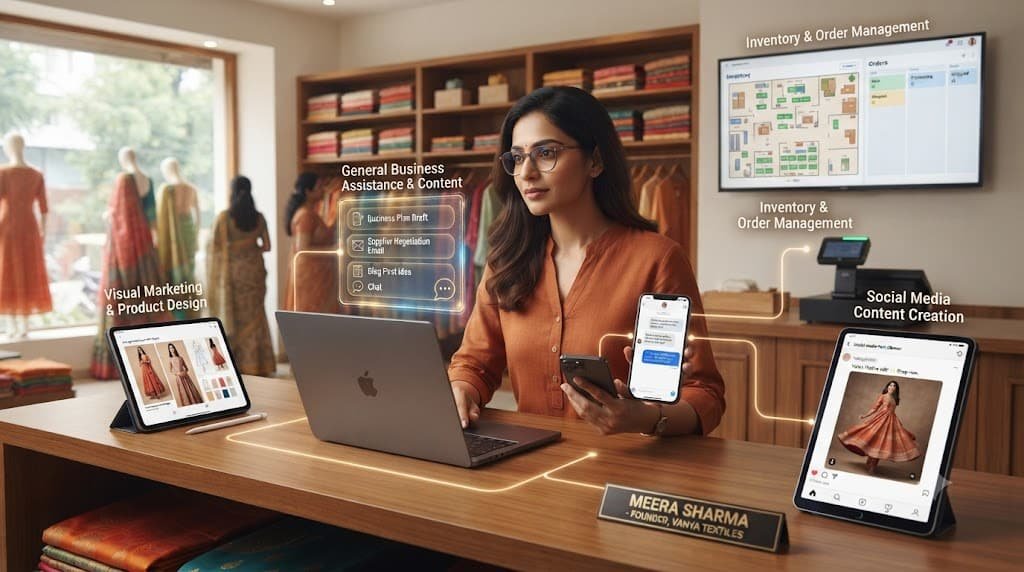
1. ChatGPT
ChatGPT is a general-purpose AI assistant, not a retail-specific platform — which is exactly where its value and its limits both come from. It doesn’t come pre-loaded with retail workflows, inventory logic, or e-commerce integrations. What it offers instead is flexibility: one tool that can move between marketing copy, customer messaging, research, and internal documentation without switching apps.
What retailers can use it for:
- Marketing copy
- Product descriptions
- Customer-response drafts
- Business brainstorming
- Research assistance
- Content calendars
- Data analysis
- SOP creation
- Staff training material
For example, a home-goods retailer could feed in a product’s specs and ask ChatGPT to generate a website description, a shorter Instagram caption, and a WhatsApp promotional message — all matched to the same product but written for three different formats.
Best suited for: Retailers who want one flexible assistant across marketing, operations, and customer communication, rather than a dedicated tool for each task.
Limitation: Because it’s general-purpose, ChatGPT doesn’t know your actual stock levels, pricing, or promotions unless you tell it — so retailers should verify prices, availability, and claims before anything generated is published or sent to a customer.
2. Canva AI
Canva AI is a design platform with AI features layered on top, not an AI image generator built from the ground up. That distinction matters: its core strength is still Canva’s existing library of templates, brand kits, and layout tools — AI here speeds up editing, resizing, and generating variations rather than replacing design judgement entirely.
What retailers can use it for:
- Social media posts
- Promotional banners
- Product catalogues
- Posters
- Advertisements
- Presentations
- Marketing graphics
For example, a local clothing shop could use Canva AI to build a consistent set of Instagram creatives for a new collection launch, using a saved brand kit so fonts, colours, and logo placement stay uniform across every post without redesigning each one from scratch.
Best suited for: Small retailers without a dedicated graphic designer who need to produce visual content regularly and consistently.
Limitation: AI-generated or AI-edited visuals should be checked carefully before publishing, especially where real product images, prices, sizes, or offers appear — small AI editing errors (a warped product shape, a wrong price overlay) are easy to miss at a glance and costly once live.
3. ManyChat
ManyChat is a messaging automation platform, not a conversational AI in the ChatGPT sense — it doesn’t reason about open-ended questions so much as route customers through pre-built flows based on triggers and keywords. Its value comes from consistency and speed, not intelligence.
What retailers can use it for:
- Frequently asked questions
- Lead collection
- Promotional campaigns
- Customer conversations
- Automated responses
- Follow-up messages
For example, a customer commenting on a retailer’s Instagram post about a sale could automatically receive a DM with the offer details and a link to the relevant product page, without a staff member needing to reply manually.
Best suited for: Retailers with a steady volume of repetitive customer questions or promotions across social and messaging channels, who want to reduce manual response time.
Limitation: The available channels, integrations, and automation depth depend entirely on the current plan and platform partnerships (Instagram, WhatsApp, etc.), which can change — so retailers should confirm compatibility with their specific channels before building a workflow around it, rather than assuming full coverage.
4. Zoho Inventory
Zoho Inventory is fundamentally an inventory and order-management platform, not an AI chatbot or content tool — it’s included here because AI is only useful for a retail business once the underlying operational data is reliable, and this is the layer that provides that.
What it helps manage:
- Inventory
- Orders
- Purchasing
- Warehousing
- Product information
- Sales processes
For a retailer selling across multiple channels — say, an in-store counter plus an online shop — Zoho Inventory keeps stock counts synced so a product doesn’t get oversold online because it was already sold in person.
Best suited for: Retailers with a growing product range who need a single, organised source of truth for stock, rather than tracking inventory across spreadsheets or memory.
Limitation: No amount of AI or automation fixes bad inventory data. If stock movements aren’t recorded accurately and consistently from day one, any AI-driven forecasting or reordering built on top of it will simply be wrong with more confidence — the process discipline has to come first.
5. Predis.ai
Predis.ai is a content-generation tool focused specifically on social media, not a full marketing or design suite — it’s narrower than Canva AI in scope, trading breadth for speed on one specific job: getting a stream of postable content out the door.
What retailers can use it for:
- Social-media posts
- Promotional content
- Captions
- Creative concepts
- Content ideas
- Marketing campaigns
For example, a retailer launching a weekend sale could use Predis.ai to generate a batch of caption and creative options for the same offer, then pick and lightly edit the two or three that best match their brand voice, instead of writing each post individually.
Best suited for: Retailers who need to post regularly but don’t have a full-time marketing or content person to keep up with that volume.
Limitation: Speed is the trade-off for specificity — generated content still needs a human check before it goes live, since it can’t independently verify that a price, offer, or availability claim in the post actually matches what’s true in the store right now.
Comparison Table
| Tool | Best For | Key Uses | Suitable For | Ease of Use | Main Strength |
|---|---|---|---|---|---|
| ChatGPT | General business assistance | Content, research, analysis, SOPs | Most retail businesses | Easy | Versatility |
| Canva AI | Visual marketing | Posts, catalogues, banners, designs | Small & medium retailers | Easy | Visual content |
| ManyChat | Customer messaging | Automation, FAQs, follow-ups | Retailers with digital audiences | Easy–Moderate | Messaging automation |
| Zoho Inventory | Inventory & orders | Stock, orders, purchasing | Growing retailers | Moderate | Inventory organization |
| Predis.ai | Social media | Posts, captions, campaigns | Retailers focused on social media | Easy | Content creation |
How to Slowly Implement AI in Your Retail Shop
Retailers do not need to transform their entire business overnight.
A gradual approach is usually easier to manage.
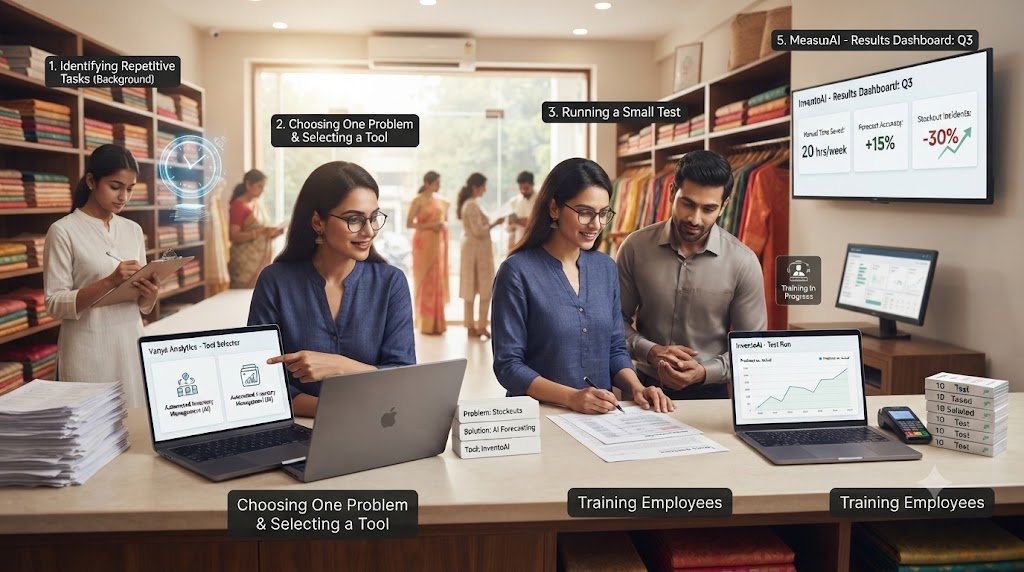
Step 1: Identify Repetitive Tasks
Write down everything you and your employees do during a typical week.
Identify tasks that are repetitive and time-consuming.
Step 2: Choose One Problem
Do not start with ten AI tools.
Choose one problem, such as creating social-media content or analyzing sales.
Step 3: Select the Appropriate Tool
Match the tool to the task.
Use a general AI assistant for writing and analysis, a design tool for visual marketing, and an inventory platform for stock management.
Step 4: Run a Small Test
Try the tool for a few weeks.
Measure whether it actually saves time or improves the workflow.
Step 5: Train Your Team
Show employees how to use the tool properly.
Explain what information can be entered, what should be checked, and when a human should make the final decision.
Step 6: Measure the Results
Look at practical metrics such as:
- Time saved
- Number of tasks completed
- Marketing output
- Response times
- Inventory accuracy
- Customer engagement
If the results are useful, gradually expand AI into other areas.
Disadvantages and Risks of Using AI in Retail
We have talked about the advantages of AI, but it is equally important to understand the disadvantages and risks of using AI in retail businesses.
- AI Can Make Mistakes
AI-generated information can sometimes be inaccurate.
A retailer should verify product specifications, prices, stock information, business policies, and other important details.
- Implementation Can Cost Money
Some advanced software platforms and automation systems require paid subscriptions or implementation costs.
A retailer should evaluate whether the expected benefit justifies the expense.
- Employees Need Training
Introducing new technology without training can create confusion.
Employees need to understand both how and when to use AI.
- Poor Data Produces Poor Results
If inventory or sales information is inaccurate, AI-based analysis can also be unreliable.
Good data management is essential.
- Privacy and Security Matter
Retail businesses may handle customer information, transaction records, contact details, and other sensitive business data.
Shop owners should understand how a tool handles data before entering confidential information.
- Over-Reliance on AI Can Be a Problem
AI should support human decision-making rather than replace business judgment.
A shop owner still understands local customers, suppliers, product quality, and market conditions in ways an AI system may not.
- Integration Can Be Difficult
A retailer may already use billing software, inventory systems, spreadsheets, accounting tools, and messaging platforms.
Connecting new AI tools to existing systems may require additional setup.
- AI Does Not Guarantee More Sales
Using AI does not automatically increase revenue.
Results depend on the quality of implementation, the business model, customer demand, products, pricing, marketing, and many other factors.
The best approach is to test AI on a specific business problem and measure the outcome.
FAQs
- What are the best AI tools for retail shop owners?
The right tool depends on the problem. ChatGPT can assist with general business tasks, Canva AI with visual marketing, ManyChat with messaging automation, Zoho Inventory with inventory management, and Predis.ai with social-media content.
- Can small retail shops use AI?
Yes. Small retailers can begin with simple tools for content creation, customer communication, data analysis, and daily productivity without immediately investing in complex enterprise systems.
- How can AI help retail inventory management?
AI and intelligent inventory systems can help analyze sales and stock information, identify fast- and slow-moving products, and support demand planning when sufficient quality data is available.
- Can AI create social-media posts for a retail shop?
Yes. AI tools can help generate captions, content ideas, promotional copy, and visual designs. The retailer should review the final content before publishing it.
- Can AI help with WhatsApp customer service?
AI-powered automation can help handle repetitive customer questions and conversations on supported messaging platforms. The exact capabilities depend on the software and integration being used.
- Is AI expensive for small retailers?
It does not have to be. Many businesses can start with relatively simple AI tools and expand only when they see a practical benefit. More advanced inventory, automation, or enterprise systems can involve additional costs.
- Can AI predict what customers will buy?
AI can analyze historical and other relevant data to help estimate demand, but predictions are not guaranteed. Retailers should combine AI analysis with their own market knowledge.
- Will AI replace retail employees?
AI can automate certain repetitive tasks, but retail still depends heavily on human interaction, product knowledge, customer service, judgment, and relationship-building. In many businesses, AI is more useful as a support tool for employees.
Bottom Line
AI is becoming a practical tool for retail businesses, not just a technology used by large corporations.
From creating marketing content and analyzing sales to organizing inventory and automating customer questions, AI tools for retail shop owners can support many everyday activities.
The key is not to adopt every AI tool available.
Start with one problem.
If marketing takes too much time, try AI-assisted content creation. If customer messages are overwhelming, explore automation. If inventory is becoming difficult to manage, improve the underlying inventory system and then consider intelligent analysis.
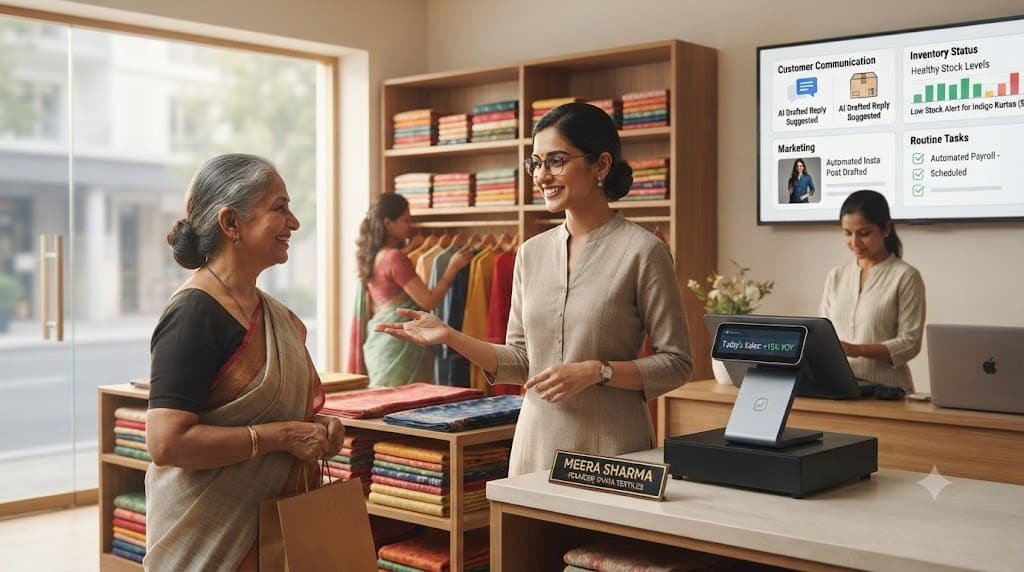
The most effective approach is to combine AI + accurate data + human experience.
For retail shop owners, the future of AI is not necessarily about replacing people. It is about giving people better tools to spend less time on repetitive work and more time focusing on customers and growing the business.
Published by Crackk.com
Crackk.com covers artificial intelligence, AI tools, automation, technology, and practical AI applications for businesses, helping founders and professionals understand how to use emerging technology effectively in real-world work.